DWF MOVIE REVIEW. “Trash Baby” is a compelling coming-of-age story that highlights the struggles of American kids in a small-town, middle-of-nowhere. The heartfelt teenage drama instantly engages viewers with its genuine concern for the characters’ innocence and how their oppressive environment hinders their healthy development, all presented through flawless filmmaking.
Milwaukie-born Jacy Mairs makes her impressive directorial debut with a personal film she also wrote, “Trash Baby.” In her notable achievement, she effectively portrays the painful growth of marginalized children in rural America.
This American teen drama, set in the late 1990s, follows Stevie (Esther Harrison), a mature 13-year-old girl curious about what older teenagers do during a hot, humid summer in Pine Park. The film shows her preference for hanging out with older, troubled kids rather than with other girls her age. Her neighbor and best friend, Edie (Chloe Kramer), supports her by teaching her to use makeup, but she is already a mom and struggles with alcohol, sex, and drugs, which the other teens take advantage of.
Stevie’s motorhome isn’t big enough; she dreams of being Britney Spears. She pushes herself to expand her horizons, but she still doesn’t know where her life is headed. She keeps thinking about how cool it is to hang out with bad company, experience drinking, drugs, and maybe one thing can lead to another.
Esther Harris is Trash Baby in Hollywood. Photo by José A Hermosillo, Copyrights 2025
Young actress Esther Harris delivers an outstanding performance, confidently anchoring her feature debut. The other talented actors also deserve recognition, including Eddie Wollrabe as the older, more mature kid in the group, Brad, and André Marc Wollrabe, his real-life brother, as Neon, the gang leader.
Director Jacy Mairs (Trash Baby). Photo by José A Hermosillo, Copyrights 2025
For director Jacy Mairs, a trailer park in Oregon was essential because the oppressive environment becomes a character in the film, illustrating how American kids grow up in harsh conditions.
Alongside “The Florida Project,” “Beast of the Southern Wild,” and “Kids,” “Trash Baby” stands out as a key film about the growth and maturity of American children.
When teens feel worthless, some form of hope must shine through. The question is whether Stevie wants to grow up and join the older teenagers’ gang, following the path of her very young single mother’s neighbor, who has no future, or continue to be Mommie’s little girl and play with dolls.
Trash Baby cast in Hollywood. Photo by José A Hermosillo, Copyrights 2025
Trash Baby cast in Hollywood. Photo by José A Hermosillo, Copyrights 2025
Director Jacy Mairs (Trash Baby) and José A Hermosillo, Copyrights 2025
Esther Harris is Trash Baby in Hollywood, and José A Hermosillo, Copyrights 2025
IF YOU ARE READING FROM A MOBILE DEVICE, CLICK: View web version FOR OTHER COOL FEATURES SUCH AS TRANSLATE POWERED BY GOOGLE, AN INTERACTIVE FILM FESTIVAL CALENDAR, AND MORE.
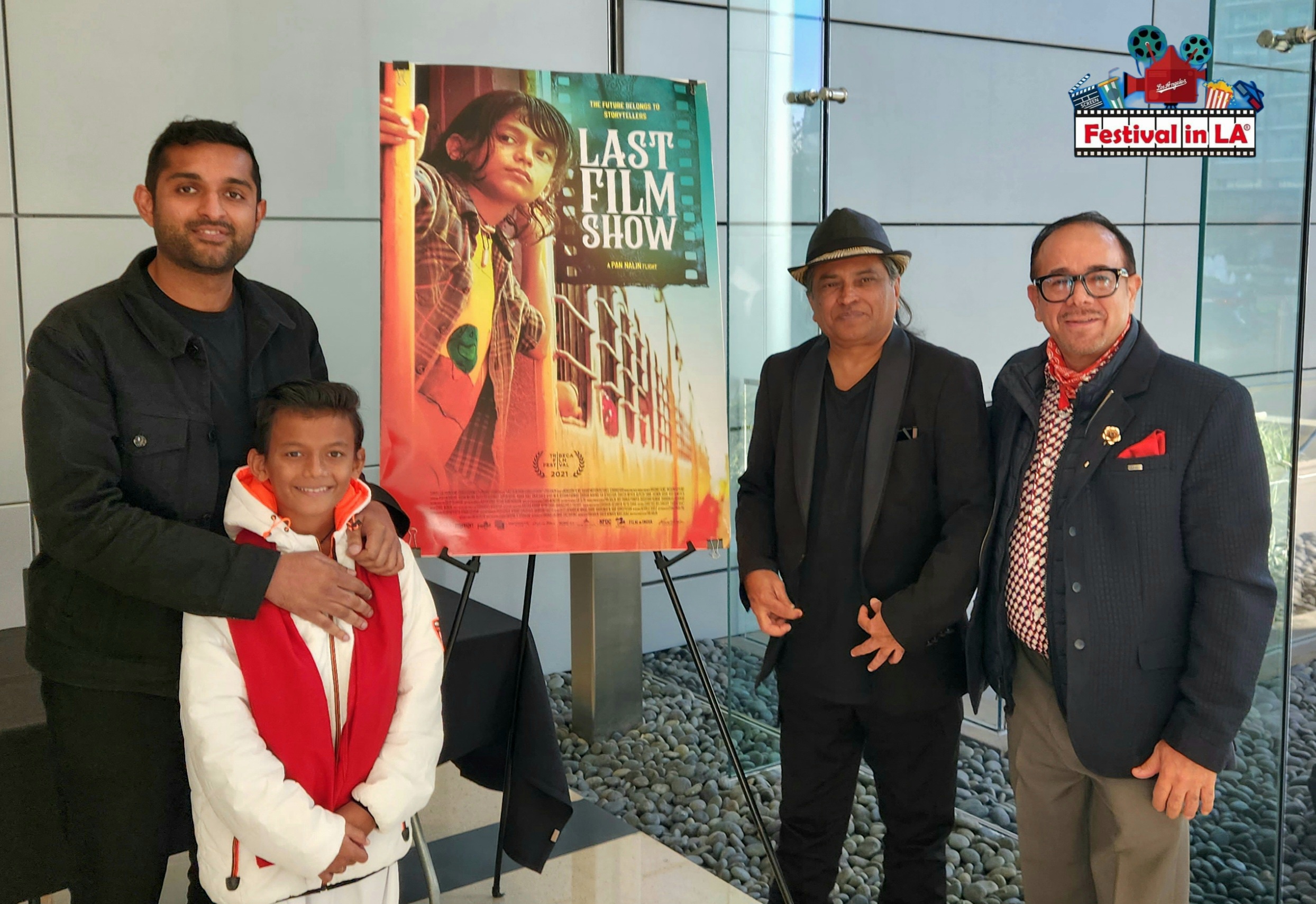
“Last
Film Show” is an unforgettable children’s adventure. It brilliantly combines Northern
Indian food and classical Marsala cinema. This memorable adventure displays India’s untamed spirit to its fullest.
The award-winning Indian drama about aging and coming of age is seen through
the eyes of a wondrous kid whose fascination with cinema extends beyond the walls of school and his family’s well-being. Samay isportrayed by newcomer Bhavin Rabari wonderfully and naturally believably.
The film
is set in the mid-1980s and unfolds organically and spontaneously, following
a young cinema lover who skips school and sneaks into the local
movie theater. He finds a way to get into the projectionist’s heart through his
stomach with the delicious school meals his mother makes daily.
Bribing
the projectionist with Marsala food is not the only trouble the kid gets into; Samay’s adventures inside the movie theater include stealing the film reels from the post office to build a projector and show those fantastic films to other kids without
electricity.
Short of understanding the transition from film to digital projection, the kid witnesses it and sees how the projectionist loses
his job to a computer-literate geek who can manage the entire movie theater with
a laptop.
Behind
the camera is the artistry of renowned Indian director/writer/producer Pan
Nalin (“Samsara,” “Angry Indian Goddess”). According to him, his film opens the
viewer’s mind to the cultural complexity of other parts of the world.
Set in Northern India, near the border with Afghanistan, the movie emphasizes marginalized
communities outside urban areas, child labor, survival, an unjust social structure, and economic conditions. For instance, people need to learn English to get
equal opportunities in education and employment. Paradoxically,
the ones who master English leave their communities as soon as possible.
The film contains well-selected clips from classic Indian cinema. Some Bollywood movies have become classics, while others are action-packed thrillers that entertain the masses. People in those movies do not look natural, says the director. In his film, he intends to be as realistic as possible by exposing people as they are and how they interact in their communities.
Regarding the question I asked in the Q&A about the combination of food and movies, Mr. Nalin answers cleverly, “The way to people’s hearts is through their stomachs.” He remembers his childhood by saying
that his mother was a great cook. Additionally, Marsala films love food and
movies because these elements draw people back to their roots in delicious, authentic food made with local, vegan products.
Inspired
by the CinemaScope of the 1950s and 60s, talented cinematographer Swapnil S.
Sonawane (“Newton” and “Dhappa”) captures perfect lighting to enhance the colors, giving the film a dazzling look.
The filmmakers sought picturesque locations and used a vibrant color palette, multichromatic sets, lavish costumes, and shiny jewelry. Everything had to be filmed on camera, not in post-production, to reflect the country’s authenticity.
Director Pan Nalin
centered his film on the life of a person he knew from the region. The more
complicated part was to bring the producers to start production. If a studio does
not back you, he recommends organizing a team to raise the money to produce the movie with other close friends, doctors, or family members who may pitch in to complete an acceptable production. “If
you’re scared, you’re dead,” he said. Because it is hard to make an
independent film in India or anywhere, he was lucky to have investors from France and the
United States to complete the movie.
Casting the kid was challenging. While looking for a professional child actor,
the famous Indian casting director Dilip Shankar (Ang Lee’s “The Life of Pi”
and Wes Anderson’s “The Darjeeling Limited”) went to the Gujarati community. He
found a confident kid named Bhavin Rabari, the son of a bus driver. The kid’s family belongs
to a tribe outside the “caste system” of other communities. The people
there feel proud of their roots, where they came from, and of the opportunities
they have to accomplish their dreams. For Bhavin Rabari, the first movie he
had ever seen in a cinema theater was his movie.
“Last
Film Show” is spoken in Gujarati with some English dialogue. The movie has been selected as India’s entry for Best International Feature Film at the 95th Academy
Awards. It has been shortlisted - beating the Netflix mega-production “RRR,” also the front-runner to win Best Original Song with “Naatu Naatu.”
The
director is surprised that his film is receiving widespread international recognition, and he is happy to have his movie seen by a broader audience on streaming platforms. Still, he recommends the theatrical experience because that is how he fell in love
with the film.
This crowd-pleasing Indian/French co-production premiered at the Tribeca Film Festival
in New York, where it won the audience award. Since then, “Last Film Show”
has become an international hit.
IF YOU ARE READING FROM A MOBILE DEVICE, CLICK: view web version FOR OTHER COOL FEATURES SUCH AS TRANSLATE POWERED BY GOOGLE, AN INTERACTIVE FILM FESTIVAL CALENDAR, AND MORE.
Stunningly photographed and well-executed, “Drunken Birds” reveals the beliefs, actions, and passions of its three uniquely opposite characters with poetic regard across Canada and Mexico.
“Drunken Birds” centers its narrative on love, abandonment, and coming-of-age memories. Divided into three acts, like “Days of Heaven,” “Amores Perros,” and “Magnolia,” the Canadian production offers a compelling dramatization not far from reality.
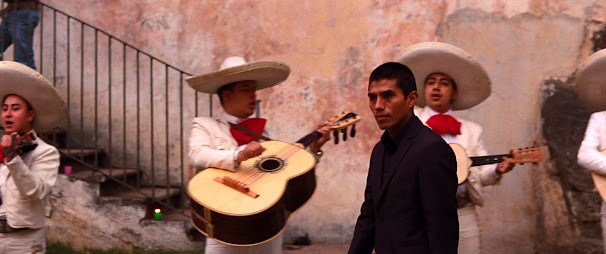
Inspired by seasonal migrant workers in Canada, the film opens with a young man arriving at an apartment complex in Montréal, then shifts to a flashback in Mexico, where it shows a mansion with white tigers and other abandoned, unrestrained animals. Then, a portrait of a man who, more than a patriarch, is a drug lord. He is spending time in prison because someone betrayed him.
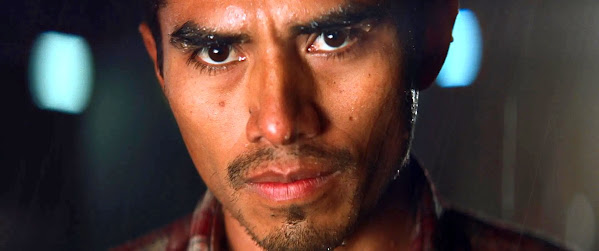
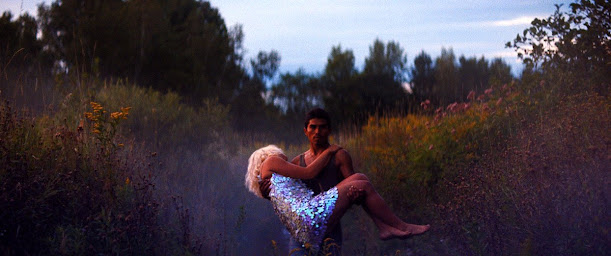
The place holds a secret: a love triangle in which Willi (Jorge Antonio Guerrero) falls for Narco’s wife, Marlena (Yoshira Escárrega). Fearing for their lives, the young lovers flee to Canada, each taking a different route.
At the Ferme, Vinet – one of the oldest agricultural centers outside Quebec – Willi, along with other seasonal workers, learns the rules and responsibilities of harvesting lettuce. Four years pass, and Willi still misses Marlena, the love of his life.
It is hard to forget a loved one, even in a tranquil oasis.
After his breakthrough performance as Fermín opposite Yalitza Aparicio in the 2018 Academy Award-winning feature “Roma,” Jorge Antonio Guerrero takes the lead in this transcendental Canadian production, playing a Mexican immigrant worker in Canada.
The story
takes a dramatic turn when Willi crosses paths with Julie (Hélène Florent), the
neglected owner of a Canadian farmhouse, and her precocious teenage daughter,
Lea (Marine Johnson), who only wants to have fun in the city.
The
complications are straightforward when their past confronts their present.
Although the conundrum keeps us wondering about possible resolutions. Everything
becomes chaotic when Lea’s silence implicates Willi in wrongdoing.
The brief
flashbacks diffuse the story’s emotional context, but the imagery’s beauty holds the narrative well.
“Drunken
Birds” is also inspired by the 2011 Mexican Oscar entry “Miss Bala.” The script
details the countries where the stories occur: Mexico, Canada, and China.
The well-balanced
cinematography is Sara Mishara’s responsibility. She accomplishes cinematic
glory by splendidly capturing the “magic hour” lighting. Sara shot the project
“Old School” with a 35mm camera. The film’s grain gave her the convenience of plenty of depth in long shots and enhanced the clarity of close-ups, giving the movie the desired “dreamlike
style.”
According to its director, Ivan Grbovic, “the characters of this intriguing triptych have distinct personalities with multidimensional layers that are not necessarily likable, although their behaviors are driven by love, desire or curiosity.” He added, “In this puzzle, all the pieces do not always fall together, but they are equally important.”
The independent production has the potential for greatness despite limited resources, although the “bad hombres”’ entrance to the hacienda in Mexico needed better choreography. There are plenty of other films in which the tension is in sync with a festive atmosphere, as seen in local productions such as Luis Puenzo’s “Old Gringo,” Baz Luhrmann’s “Romeo + Juliet,” and Ruy Guerra’s “Eréndida.”
“Drunken Birds,” winner of Best Cinematography at the Philadelphia Film Festival, premiered at the Toronto International Film Festival. It was selected as Canada’s Best International Feature Film entry for the 94th Academy Awards.
Willi’s noble heart compels him to help the needy, which is in his nature, even if it causes trouble with dramatic consequences in his immediate future. We have to remember that no one is guilty until proven otherwise, and no one is blameworthy until the truth comes out, but we are certainly not sure that will ever happen in fiction.
The filmmakers said that people in Canada associated the word “drunk” with love or joy, and birds with unity and migration. It is like a flock of birds moving together instinctively in complete freedom, just as we relate to the film’s characters’ stories effortlessly.
The climax of “Drunken Birds” or “Les Oiseaux ivres” occurs when the three stores converge at a single point. At that precise moment, justice is most urgently needed, yet the irony is that we cannot always get what we want in life, and we must remember that the greatest enemy of all is silence.
IF YOU ARE READING FROM A MOBILE DEVICE, CLICK:
view web version FOR OTHER COOL FEATURES SUCH AS TRANSLATE POWERED BY
GOOGLE, AN INTERACTIVE FILM FESTIVAL CALENDAR, AND MORE AWESOME ARTICLES.
AFI FEST REVIEW: “What Will People Say” is a compelling coming-of-age story with global repercussions and rich image composition.
The Norway-German-Swedish co-production recounts the story of Nisha (Maria Mozhdah), a young and free-spirited Pakistani teenager living with her ultra-conservative Muslim family in Norway.
At home, the girl follows the rules. In school, she feels liberated, and dresses and behaves like other “Norwegian” girls of her age.
While she desires to try her first sexual experience with her boyfriend, she gets caught and punished.
Nisha’s father takes her back to their home country, where she will get a more rigorous discipline.
Nisha's martyrdom starts with the learning process. Her millenarian culture gets more painful when her dignity as a woman is trodden by the barbaric defamation of her persona.
For Nisha, things get even worse when her physical safety is placed in danger.
“What Will People Say” is a compelling, contemporary drama elevated to a higher level of affection by its director Iram Hay, an Oslo born female writer, director, and actress. In this, her second feature, she shows an enormous talent and incommensurable vision influenced by the global problem of immigration.
"What Will People Say" Poster in Spanish.
"What People Will Say" is the Audience Award Winner of the AFI Fest 2017 and now the official Norwegian entry to the 91st Academy Awards. It is a worthy representative of the contemporary Scandinavian culture.
“Kicks” is one of the year’s best and freshest independent films, yet it is ingenious and original.
This new coming-of-age story builds tension over eighty minutes as characters survive in America’s slums.
Courtesy of Focus Features
The first fifteen minutes of the film feel like the most extended Nike Air Jordan commercial ever. This story is not about an ordinary tennis shoe; it is about “THE JORDANS.”
Once the main character starts looking for what is worth in life, the action takes off.
Courtesy of Focus Features
In the suburbs of Oakland, California, we meet Brandon (Jahking Guillory), an introverted teenager who likes to hang out with his older buddies, Rico (Christopher Meyer) and Albert (CJ Wallance). They love to smoke, drink, and rap.
After being beaten up in a humiliating incident, Brandon and his friends set out on a quest to recover his most prized possession, his stolen tennis shoes.
A confrontation like that happens all the time, anywhere; it is real - people can get killed over a backpack.
Courtesy of Focus Features
In “Kicks,” the city is one of the main characters.
The teen drama moves from a small, impoverished ghetto to a more significant and more dangerous part of the town, where the big boys play with huge cars, easy girls, loaded guns, and plenty of drugs.
Courtesy of Focus Features
While the meanest guy in the “barrio,” Flaco (Kofi Siriboe), physically abuses Brandon (14), his five-year-old is also being abused.
Flaco is played by Kofi Siriboe. Courtesy of Focus Features
Flaco tries to teach a lesson to his son, but he has no moral authority over him - this is a fundamental element woven through the plots and subplots of the movie.
“Kicks” underlines a cycle of abuse. The irony comes when someone preaches respect while failing to respect the vulnerable.
Courtesy of Focus Features
The young actors in “Kicks” are terrific. They had fun working with director Justin Tipping.
Justin said, “I was terrified the first day of shooting! It was a weird experience, and at the same time, it was incredible to work with all those talented kids.”
Director, co-writer Justin Tipping, Photo by José A Hermosillo, Copyright Festival in LA, 2016
“Kicks” is a remarkable film debut for director Justin Tipping.
The film’s musical evolution unfolds the drama.
The director cleverly incorporates hip-hop early on to foreshadow the rap that plays later, showing the transformation of a fragile teenager into a robust young adult.
Jahking Guillory as Brandon, Photo by José A Hermosillo, Copyright Festival in LA 2016
In other parts of the world, some movies about troubled kids have been made in a similar tone. For example, the award-winning Mexican production “Güeros,” last year’s independent sensation “Dope,” the Oscar-winning “Tsotsi” from South Africa, “My Brother the Devil” from the U.K., and the iconic “Boys n the Hood” by John Singleton.
A ray of hope shines in the desolate universe of “Kicks,” where friendship remains unbroken. The film is slightly predictable but satisfies the audience, who cheer for the main character, the vulnerable teen who wants to take justice into his own hands. Whether he succeeds or not, it is worth trying.