Showing posts with label 95th Academy Awards. Show all posts

Friday, April 14, 2023

Joyland: A Cinematic Rejoice from Pakistan

By José Alberto Hermosillo

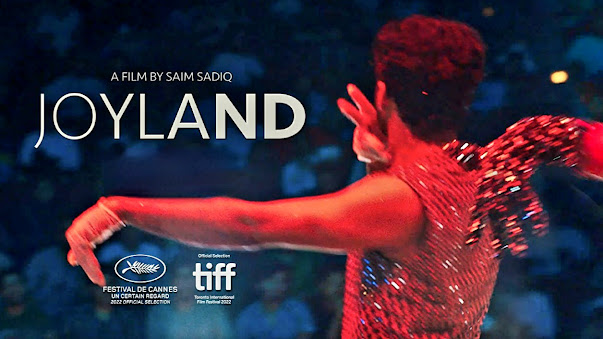
“Joyland” is a poignant allegory of love, despair, and melancholy—an achievement in Pakistani cinema.


“Joyland” challenges consciences on many levels, serving as both a powerful coming-of-age story and a reflection of a society that denies essential rights, such as inclusion, free speech, and equal opportunities for everyone, including those who think outside the box. In life, we often generalize and stereotype others, but instead, we should analyze and evaluate each person as a vital part of the community.


The film focuses on Haider Rana (Ali Junejo) and his conservative family. He lives with his wife, Mumtaz (Rasti Farooq), his father, mother, and his older brother’s family in Lahore, Pakistan.


Haider is an unemployed, hardworking, and shy man who lands a job as a backup dancer in a Bollywood-style burlesque show. Soon, the helpful and naïve man falls for Biba (Alina Khan), a sparkling trans woman who hosts a show at a nearby theater. As circumstances grow more complicated, Haider must navigate his double life carefully.


Biba shares a simple but meaningful joke with Haider: “The chicken and the mosquito shared a kiss. Then, the mosquito died of bird flu... the chicken died of dengue.” She then explains: “Because falling in love means death.” The joke highlights two main, opposing characters: the religious married man and the openly gay transgender person seeking freedom in a conservative society with strict laws.


The vibrant production centers on three distinct and memorable characters: Haider, Mumtaz, and Biba.


For Haider, his family is as crucial as the show’s success. He takes Biba’s safety seriously and cares about his family’s well-being, but balancing everything in real life isn’t easy.


Mumtaz is emotionally fragile. She wants to be pregnant but doubts her husband’s job because of his frequent absences.


Biba’s multidimensional character is neither sugar-coated nor does she pretend to be cute. She is an energetic, confident, and trustworthy trans woman who aspires to emigrate to Germany. Her honesty causes her to reject those who care for her, including Haider. Alina Khan’s performance is as impressive as Daniela Vega’s in the award-winning Chilean film “A Fantastic Woman.”


What is more remarkable about this moving production is that, despite featuring extraordinary actors, it was their first experience acting in films.


 Saim Sadiq, "Joyland." Photo by José Alberto Hermosillo. Copyright © FestivalinLA

First-time writer-director Saim Sadiq describes “Joyland” as a deeply personal project because he comes from a diverse, middle-class family that is also trying to climb the social ladder, much like the characters in his film. Still, he has to recognize that people in Pakistan live in a patriarchal society that imposes limits on progress, love, and desires.


Director Saim Sadiq created an honest and balanced script that consistently emphasizes the “trans” theme and social conflict, building a strong dramatic arc and an open ending. Politically, Saim acknowledges the influence of the extreme right wing in his country and admits that his work will likely upset many. He mentioned that after screening his controversial film in Pakistan, he didn’t expect everyone to stay and applaud. Still, he hoped his film would inspire people to enjoy it, reflect on it, and continue thinking about it.


The highly acclaimed Pakistani film transcends barriers of freedom and acceptance.


It won the Jury Award at Un Certain Regard, Cannes 2022. It also received Best International Film at the Independent Spirit Awards 2023 and Best Artistic Contribution at the Cairo International Film Festival in Egypt. The celebrated movie earned Best Ensemble at the Bangkok Film Festival and the Audience Award at the Valladolid International Film Festival in Spain.


“Joyland” was Pakistan’s submission for Best International Feature Film at the 95th Academy Awards and was one of the fifteen films shortlisted.


The unexpected twists of “Joyland” take us to places we’ve never experienced before. The film’s vibrant urban settings, colors, and textures, combined with compelling storytelling, elevate the cinematic experience and draw viewers into the story.


More importantly, it is crucial to highlight the vibrant Pakistani youth who work hard and aspire to explore new horizons beyond their family’s boundaries, free from social restraints.


In “Joyland,” every character genuinely seeks acceptance, love, and respect, while audiences witness the struggle, beauty, and diversity of Pakistani society and other communities worldwide.

JOYLAND | OFFICIAL TRAILER

Violette: When Women Dare to Write  

IF YOU ARE READING FROM A MOBILE DEVICE, CLICK: View web version FOR OTHER COOL FEATURES SUCH AS TRANSLATE POWERED BY GOOGLE, AN INTERACTIVE FILM FESTIVAL CALENDAR, AND MORE AWESOME ARTICLES.

Festival in LA ©2023

Wednesday, March 1, 2023

A House Made of Splinters: And the Shattered Children of Ukraine

 By José Alberto Hermosillo

A House Made of Splinters
A House Made of Splinters: And the Shattered Children of Ukraine

“A House Made of Splinters” is a powerful and moving documentary of extraordinary beauty made in Ukraine before the invasion. It is emotionally devastating.


The documentary follows the lives of several Ukrainian children inside a shelter where they find refuge during the chaos of the outside world.


The chaos in Ukraine occurs within every broken family, impacting the most vulnerable—children.


Things seem to be going smoothly in a children’s refuge in East Ukraine. Outside the facility, people still feel the early signs of war and stay inside their homes. This story takes place a year or two before the Russian invasion and during earlier conflicts.


The facility’s director describes the situation as overwhelming and complicated. The film pairs her caring narration with distant shots of the impoverished Eastern European country. She says, “Life was difficult, but the war worsened things. So many people lost their jobs. Now, every tenth door hides a broken family. When a family is broken due to alcoholism, violence, or homelessness, the social worker brings the children to our shelter.”


The Oscar-nominated docudrama beautifully depicts children actively engaging with their teachers and classmates. However, the children miss their parents and still want to stay in contact, even though they know their parents are alcoholics and cannot be reached. The children experience the joy of friendship, their first love, the heartbreak that follows, loneliness, and the hope that comes with it.


The children speak, in first person, about their experiences with domestic violence and physical abuse, and some have even witnessed the murder of a parent. The unseen chaos of war zones is brought into their homes, causing anxiety, depression, and internal conflicts.


Moving the children from the shelter to an orphanage or foster family is difficult for some, especially if they have siblings still at the center. Breaking up families is always upsetting and emotionally challenging for the young ones.


When grandparents or a mother visit or pick up a child, their joy is overwhelming and unmistakable.


The exceptional camerawork by cinematographer and director Simon Lereng Wilmont captures an intimate space where shelter residents can interact naturally. Mr. Wilmont patiently waits for the right moments to capture the children’s most tender and honest moments as they open up with bravery and sincerity.


In “A House Made of Splinters,” each child’s story follows a similar pattern—Sasha, Kolya, Eva, Zhenyia, Kristina, and Polina. Most of them need professional help because it’s heartbreaking to feel that nobody wants them. These memories will stay with them forever. No one deserves to feel unwanted.


When a girl grows up, she can also become a mother, and she might struggle with alcoholism and potentially give up her parental rights to a foster family. For Ukrainian children, the future does not look promising.


El cuarto desnudo/The Naked Room

Another profound and analytical documentary on children’s psychology and mental conflicts is “El cuarto desnudo/The Naked Room,” directed by Nuria Ibañez in 2013. It portrays children undergoing psychological evaluation and receiving special treatment in a hospital with bare walls in Mexico City.


“A House Made of Splinters” keeps viewers engaged and wondering about the future of these vulnerable children. They are not necessarily victims of their parents’ actions or their violent environment, but they must still live within their circumstances.


The children need to be loved, and we all must learn to appreciate beauty and vitality, as “hope does last.” The film ends with a lullaby, leaving us feeling heartbroken, helpless, and powerless. 


Related Articles:
Laura Pausini: Pleased to Meet You, Recounts the Life of the Italian Megastar

IF YOU ARE READING FROM A MOBILE DEVICE, CLICK: view web version FOR OTHER COOL FEATURES SUCH AS TRANSLATE POWERED BY GOOGLE, AN INTERACTIVE FILM FESTIVAL CALENDAR, AND MORE AWESOME ARTICLES.

Festival in LA ©2023 

Friday, December 30, 2022

The Boy, The Mole, The Fox and The Horse: Poetry in Animation

By José Alberto Hermosillo  

“The Boy, The Mole, The Fox and The Horse” is an animated short film about love, friendship, and kindness. This thought-provoking adaptation is truly a masterpiece. Evocative, environmental, poetic, and artistic animation creates the feeling of watching a watercolor painting or a Rembrandt.


“The Boy, The Mole, The Fox and The Horse,” produced by J.J. Adams and Woody Harrelson, is directed by Peter Baynton and Charlie Mackesy, adapted from Charlie Mackesy’s bestseller by Jon Croker and Charlie Mackesy himself. 

Behind the calm sound of the characters’ voices are the talents of Jude Coward Nicoll, who plays The Boy, and Tom Hollander (“The White Lotus”), as The Mole. Idris Elba is the quiet Fox, and The Horse is played by veteran actor Gabriel Byrne (“Spider,” “End of Days,” “Stigmata”). The Boy encounters The Mole in the middle of a beautiful, frosty landscape, and being lost is unsuitable for either. 

TMoleole, hungry and blind, confused a big tree with a cake. The two new friends approached the tree, climbed the branches, and looked for an unknown river that would guide the Boy back to his home. 

At that particular place and time, Moleole asks the Boy, “What do you want to be when you grow up?” The Boy firmly answers, “Kind.” Even though the Boy is already kind, he does not want to change when he grows up because he wants to continue treating everyone with kindness and respect.


Contemplating the horizon—searching for that river—the Mole-inspired expressions say, “So much beauty we need to look after.” “Yes, so much,” replies the Boy. In that moment, we felt that there was a friend who would always be there to help. 

The heartfelt story teaches us to strengthen our inner resilience with the support of our diverse, close friends through philosophy and poetry. Many existential questions emerge, such as tMole'se’s “Can you believe in me more than I do?” which concludes with “Life is difficult, but you are loved.” At one point, Fox admits that he is quiet because he has nothing interesting to say.


The Horse’s experience and confidence ensure that others continue the journey safely. Just like in the “Wizard of Oz,” they must find out if there is a home for the Boy at the river’s end. All four characters support each other and share the same mantra, “asking for help isn’t giving up,” said the Horse, “It’s refusing to give up.” “Tears fall for a reason; they are your strength, not your weakness.”


“When things are out of control, you must focus on what you love right under your nose,” says tMoleole. That is why we are here, to love and be loved.


This original British BBC/Apple TV Plus production has been nominated for Best Animated Short Film at the 95th Academy Awards. “The Boy, The Mole, The Fox, and The Horse” is among the top contenders for the Oscar, joining other notable animated short winners like “Dear Basketball,” “Mr. Hublot,” “The Danish Poet,” and “Peter & the Wolf.”


Watching this short artistic piece brings up questions, such as how cold it must be for a boy to be outside without a jacket. What will the friends eat, and how will they protect themselves from environmental dangers and predators?


“The Boy, The Mole, The Fox, and The Horse” is a charming, innocent, and beautiful animated film that teaches kids important lessons on becoming better humans. 

The Boy, the Mole, the Fox and the Horse — Official Trailer | Apple TV+

The 15 Shortlisted Animation Shorts are:
Black Slide
The Boy, the Mole, the Fox and the Horse
The Debutante
The Flying Sailor
The Garbage Man
Ice Merchants
It’s Nice Here
More than I Want to Remember
My Year of Dicks
New Moon
An Ostrich Told Me the World Is Fake, and I Think I Believe It
Passenger
Save Ralph
Sierra
Steakhouse

Related Articles:  
IF YOU ARE READING FROM A MOBILE DEVICE, CLICK: view web version FOR OTHER COOL FEATURES SUCH AS TRANSLATE POWERED BY GOOGLE, AN INTERACTIVE FILM FESTIVAL CALENDAR, AND MORE.

Festival in LA ©2022