
By José Alberto Hermosillo

“Last Film Show” is an unforgettable children’s adventure. It brilliantly combines Northern Indian food and classical Marsala cinema. This memorable adventure displays India’s untamed spirit to its fullest.
The award-winning Indian drama about aging and coming of age is seen through the eyes of a wondrous kid whose fascination with cinema extends beyond the walls of school and his family’s well-being. Samay is portrayed by newcomer Bhavin Rabari wonderfully and naturally believably.
 |
| Bhavin Rabari is Samay in “Last Film Show.” Photo: José Alberto Hermosillo, CAA (Creative Artists Agency), Century City, Los Angeles, CA. www.FestivalinLA ©2022 |
The film is set in the mid-1980s and unfolds organically and spontaneously, following a young cinema lover who skips school and sneaks into the local movie theater. He finds a way to get into the projectionist’s heart through his stomach with the delicious school meals his mother makes daily.
Bribing the projectionist with Marsala food is not the only trouble the kid gets into; Samay’s adventures inside the movie theater include stealing the film reels from the post office to build a projector and show those fantastic films to other kids without electricity.
Short of understanding the transition from film to digital projection, the kid witnesses it and sees how the projectionist loses his job to a computer-literate geek who can manage the entire movie theater with a laptop.

 |
| Director Pan Nalin & actor Bhavin Rabari “Last Film Show.” Photo: José Alberto Hermosillo, CAA (Creative Artists Agency), Century City, Los Angeles, CA. www.FestivalinLA ©2022 |
Set in Northern India, near the border with Afghanistan, the movie emphasizes marginalized communities outside urban areas, child labor, survival, an unjust social structure, and economic conditions. For instance, people need to learn English to get equal opportunities in education and employment. Paradoxically, the ones who master English leave their communities as soon as possible.
The film contains well-selected clips from classic Indian cinema. Some Bollywood movies have become classics, while others are action-packed thrillers that entertain the masses. People in those movies do not look natural, says the director. In his film, he intends to be as realistic as possible by exposing people as they are and how they interact in their communities.
Regarding the question I asked in the Q&A about the combination of food and movies, Mr. Nalin answers cleverly, “The way to people’s hearts is through their stomachs.” He remembers his childhood by saying that his mother was a great cook. Additionally, Marsala films love food and movies because these elements draw people back to their roots in delicious, authentic food made with local, vegan products.
Inspired by the CinemaScope of the 1950s and 60s, talented cinematographer Swapnil S. Sonawane (“Newton” and “Dhappa”) captures perfect lighting to enhance the colors, giving the film a dazzling look.
The filmmakers sought picturesque locations and used a vibrant color palette, multichromatic sets, lavish costumes, and shiny jewelry. Everything had to be filmed on camera, not in post-production, to reflect the country’s authenticity.
Director Pan Nalin
centered his film on the life of a person he knew from the region. The more
complicated part was to bring the producers to start production. If a studio does
not back you, he recommends organizing a team to raise the money to produce the movie with other close friends, doctors, or family members who may pitch in to complete an acceptable production. “If
you’re scared, you’re dead,” he said. Because it is hard to make an
independent film in India or anywhere, he was lucky to have investors from France and the
United States to complete the movie.
Casting the kid was challenging. While looking for a professional child actor,
the famous Indian casting director Dilip Shankar (Ang Lee’s “The Life of Pi”
and Wes Anderson’s “The Darjeeling Limited”) went to the Gujarati community. He
found a confident kid named Bhavin Rabari, the son of a bus driver. The kid’s family belongs
to a tribe outside the “caste system” of other communities. The people
there feel proud of their roots, where they came from, and of the opportunities
they have to accomplish their dreams. For Bhavin Rabari, the first movie he
had ever seen in a cinema theater was his movie.
 |
| Producer Dheer Momaya, Child actor Bhavin Rabari, director Pan Nalin, “Last Film Show.” Photo: José Alberto Hermosillo, CAA (Creative Artists Agency), Century City, Los Angeles, CA. FestivalinLA ©2022 |
“Last Film Show” is spoken in Gujarati with some English dialogue. The movie has been selected as India’s entry for Best International Feature Film at the 95th Academy Awards. It has been shortlisted - beating the Netflix mega-production “RRR,” also the front-runner to win Best Original Song with “Naatu Naatu.”
The director is surprised that his film is receiving widespread international recognition, and he is happy to have his movie seen by a broader audience on streaming platforms. Still, he recommends the theatrical experience because that is how he fell in love with the film.
This crowd-pleasing Indian/French co-production premiered at the Tribeca Film Festival in New York, where it won the audience award. Since then, “Last Film Show” has become an international hit.
LAST FILM SHOW (Chhello Show) Official Trailer
“Last Film Show” Indian Child Actor Talks About His Experience Making the Film
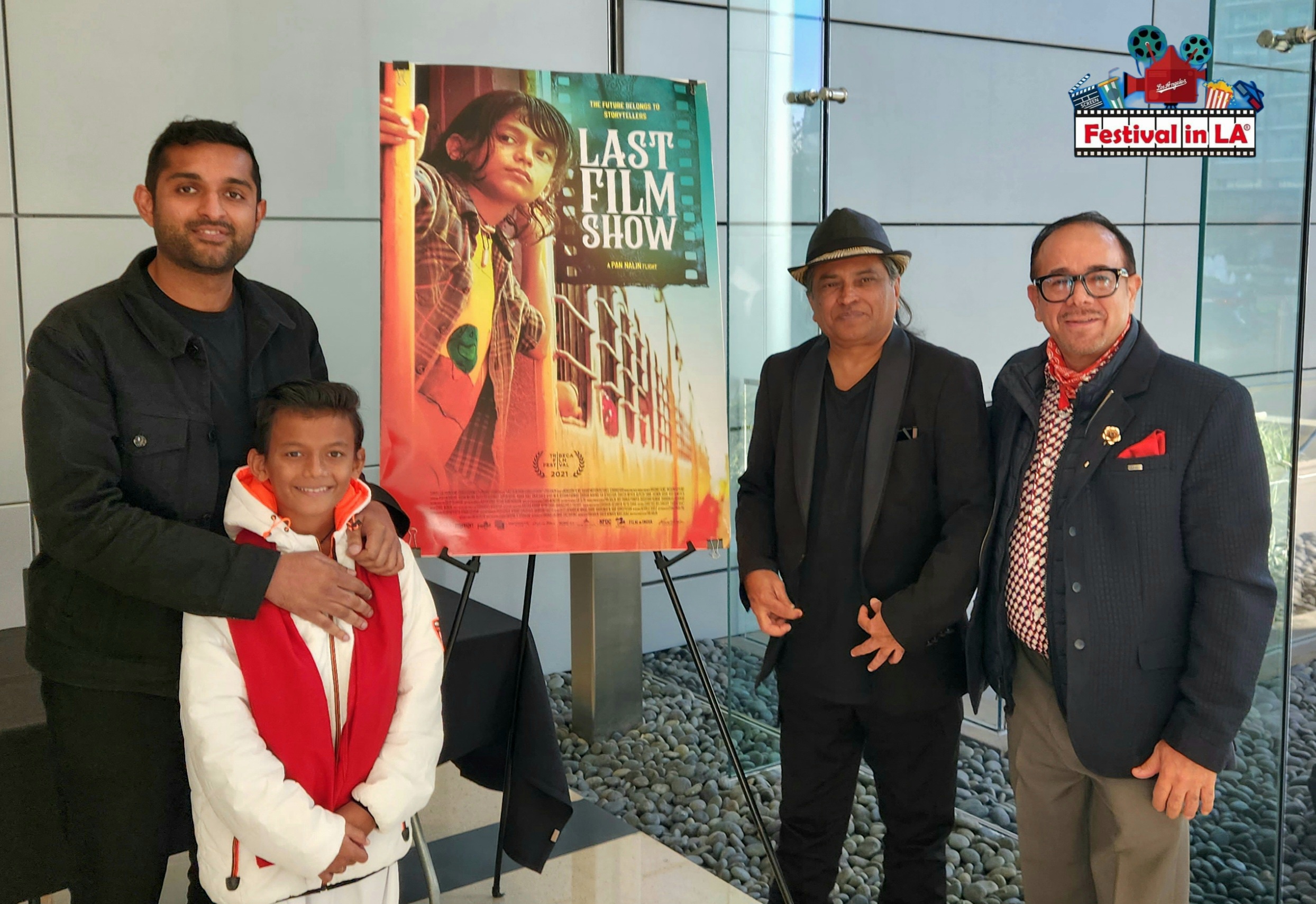 |
| Producer Dheer Momaya, Child actor Bhavin Rabari, director Pan Nalin, “Last Film Show,” and film critic José Alberto Hermosillo, CAA (Creative Artists Agency), Century City, Los Angeles, CA. FestivalinLA ©2022 |
 |
| Child actor Bhavin Rabari is Samay in “Last Film Show” and film critic José A. Hermosillo, CAA (Creative Artists Agency), Century City, Los Angeles, CA. FestivalinLA ©2022 |
Naatu Naatu Oscar-winning composer M.M. Keeravani & director S.S. Rajamouli Q&A @ CAA, Los Angeles
Troop Zero: Young Earthlings on an Astounding Mission


Nice
ReplyDeleteI just read your blog post about "Last Film Show" and I really loved it! You really captured the essence of what "Last Film Show" was about and how it felt to watch the film.
ReplyDelete123 Malayalam Movies