Showing posts with label Best International Feature Film. Show all posts

Friday, November 21, 2025

A Poet: A Lost Soul in Medellin

 By José Alberto Hermosillo


AFI FEST MOVIE REVIEW: “A Poet” is a captivating Colombian drama with conscience. Its comedic elements soften its darker, yet universal, themes.


The story focuses on Oscar, played by newcomer Ubeimar Rios, who powerfully depicts a middle-aged, frustrated, and depressed alcoholic. Years earlier, he published a book of poems in Medellín. His past achievements, honors, and recognition hold him back from pursuing a career as a poet due to ongoing writer’s block. His life changes when his family urges him to accept a high school teaching position, where he begins to see a glimmer of hope in a talented yet underprivileged student.

Director Simón Mesa Soto, a well-educated high school philosophy teacher in Medellín who speaks fluent English, prefers working with non-professional actors. Soto skillfully condensed and transformed his well-structured and solid second project into an award-winning international success, taking it from Colombia to Cannes, where it won the Un Certain Regard Jury Prize, and then to Los Angeles, where it served as the official Colombian Oscar entry in the Best International Feature Film category.

Years ago, when he was about to give up filmmaking, he considered becoming the worst version of himself rather than abandoning his passion. While writing the screenplay “A Poet,” he aimed to create an authentic, true-to-himself character. His creative process reflects his genuine beliefs about life. The story begins by highlighting the poet’s struggles, including financial hardship, depression, and alcoholism. The director also mentioned that working as a teacher in Colombia can be tough for making ends meet.

After screening at the AFI Fest in Los Angeles, the confident director said that while he was searching for the right performer, a friend recommended a high school teacher he knew. After seeing him, Simón hired Ubeimar to join the supporting cast to play one of the other poets. He wasn’t initially convinced that Mr. Ríos was the right person to portray the complex role of the true poet he envisioned.

Taking a risk, Simón chose Mr. Ríos to play Oscar, a decision that changed the public’s view of the character. Ríos trained for two months to perfect his acting technique, and he naturally called it a lucky coincidence. In Oscar’s case, his lack of empathy draws others to him, making him the perfect underdog who connects with viewers.

“A Poet” employs a more abstract, atmospheric storytelling style, which Simón described as a return to a rawer approach designed to reconnect with his Colombian audience. He structured the film around a dilemma to reflect the uncertainty in his own life.

On a technical level, shooting on 16mm film gives the project the raw texture the director wanted, resulting in a unique look with vivid colors and sharp resolution.

Oscar is a character lost in the past. Despite facing societal prejudices—along with misunderstandings of minor abuses, battling alcohol and drugs, poverty, and marginalization—he continues on a complex, contradictory path like jazz partiture.

Director Simón Mesa, “APoet.” Photo by José Alberto Hermosillo, wwwFestivalinLA.com

Simón Mesa Soto explained that his motivation for making the film stemmed from his frustration at not being able to work in cinema as often as he wanted. He surprisingly finished “A Poet” in six months, leading up to its Cannes premiere in May 2025. He mentioned a few times how difficult it is to make a film in Colombia. He is the lucky one, compared to others who spend decades in Los Angeles trying to break into Hollywood without any success.

In one of the earliest and most intense scenes in the film about euthanasia, the audience might want to look for the nearest exit. It’s when the poet talks with his elderly and sick mother about helping her die and contemplating suicide— a conflicting and personal choice for viewers like me who value life deeply. I’m glad I stayed until the end to enjoy this magnificent film full of light and meaning.

There’s a noticeable influence of Soto’s work on that of his fellow countryman, Gabriel García Márquez, which is essential to recognize, although Soto disagrees. “A Poet” hints at Latin American magical realism, similar to the works of the Nobel laureate, who also wrote notable screenplays in Mexico and Cuba, including Alberto Isaac’s “En este pueblo no hay ladrones/There are No Thieves in this Village” (1965). Arturo Ripstein’s debut “Time to Die” (1966), Ruy Guerra’s “Erendida” (1983), and Fernando Birri’s “A Very Old Man with Enormous Wings” (1988).


“A Poet” continues the tradition of films about suicidal alcoholics; a similar case is presented in Wilder’s “The Lost Weekend,” which won the Oscar for Best Picture in 1945 and portrays intense depression and unrelenting drinking. In Mike Figgis’s 1995 film “Leaving Las Vegas,” Oscar-winning Best Actor Nicolas Cage also plays an alcoholic on a suicidal mission.

Despite the tragic and disheartening circumstances, “A Poet” explores themes of innocence, honesty, family values, and awakening—elements that engage the audience and foster appreciation for a genuinely moving work of art.


” A Poet” depicts how society views us when we lose our freedom, trapping us in small shells, isolating us, and dimming our hopes for the future. Here, the future is symbolized by the youth of Latin American countries—a vital fountain of resources. Whether they write poems or work in a nail salon, they still hold on to dreams, goals, and desires.

Related Articles
Passages: A Sui Generis Love Affair in Paris
The Missing: Nightmares, Aliens in a Filipino Love Story
The New Boy: Politically, Spiritually and Religiously Australian
Afire: Fire in a Poignant German Holiday
Undine: Dangerous Liaisons in Berlin
A Fantastic Woman: Love, Grief, and Compassion in Santiago
The Mole Agent: No “Mission Impossible” for a 90-Year-Old Chilean Detective
Joyland: A Cinematic Rejoice from Pakistan
The New Girlfriend: A New Trend in Transgender Cinema
Cassandro: From a Mexican Wrestler to a Superhero in Drag
Desde Allá: Confronts the Macho Stereotypes
Violette, When Women Dare to Write
Synonyms: A Good Jew in Paris
The Silence of Others: Speaks Up in Amnesiac Spain 
The Eternal Memory: An Indelible Story of Love and Alzheimer
Navalny: The Russian Dissident Who Shocked The World
In Viaggio: The Travels of Pope Francis: A Message of Hope

IF YOU ARE READING FROM A MOBILE DEVICE, CLICK: view web version FOR OTHER COOL FEATURES SUCH AS TRANSLATE POWERED BY GOOGLE, AN INTERACTIVE FILM FESTIVAL CALENDAR, AND MORE AWESOME ARTICLES.

Festival in LA ©2025

Monday, February 12, 2024

Shayda; “A Separation” in Australia

By José Alberto Hermosillo

AFI FEST FILM REVIEW: “Shayda” is a thoughtful and profoundly moving family drama. It chronicles the journey of an Iranian mother and daughter as they endure a painful separation from their abusive husband in Australia in the 1990s.

Paraphrasing the title of the Oscar-winning 2011 Iranian film “A Separation,” directed by Asghar Farhadi, another story of separation among Iranians comes to the screen -- “Shayda,” based on the personal experience of first-time Iranian Australian director Noora Niasari, delivers a vivid portrayal of an abused Iranian single mother and her daughter as they wander in a foreign land.

Director Noora Niasari, Australia. Photo by José Alberto Hermosillo. Copyright © Festival in LA, 2023

 
The film strongly suggests Shayda’s darkest moments, including the reference to when she was beaten, raped, and sent out onto the street with her six-year-old daughter, Mona. To overcome adversity, she seeks refuge at a women’s shelter, where she finds counseling, legal aid, and friends in similar circumstances who teach her to empower herself to confront her husband and his family.


Over the Persian New Year celebration, Shayda would like to take comfort in the Nowruz rituals that symbolize a new beginning. But real life takes work. Escaping domestic violence and her country’s totalitarian ideology, Shayda needs to recapture her cultural identity by staying connected to her Iranian food, poetry, music, dances, traditions, and, above all, the Iranian people in Australia.


In this stressful cat-and-mouse drama, Shayda must be as far as possible from her abusive husband, Hossain (Osamah Sami), but the law does not grant her wishes. The patriarchal Australian system, unaware that the father wants to take his woman and daughter back to Iran to preserve his misogynist dominance, rules in favor of the father’s visitations.


The collaborative effort took six years to come to fruition. Noora’s mother was not only her inspiration but also stood by her side during production. Academy Award-winning actress Cate Blanchett, who served as an executive producer, was an essential part of the project, Niasari said at a Q&A after the screening of her film during the AFI Fest in Los Angeles in 2023.


The Persian-born director Noora Niasari, who grew up in Australia, returned to Iran at 19 to learn more about her roots, cultural identity, and other elements that would enrich the film. The symbolism of Shayda’s clothes, shapes, and colors represents the emotional journey and transformation, visually turning Shayda’s silhouette into a butterfly. 


In terms of place and time, the film powerfully analyzes how immigrants lived in Australia during the 1990s.


Actress Zar Amir Ebrahimi, Photo by José Alberto Hermosillo. Copyright © Festival in LA, 2023

Starring Tehran-born actress Zar Amir Ebrahimi (“Holy Spider” & “Tatami”) is as remarkable as Shayda. She displays a wide range of emotions, portraying a mother who is aware of her daughter’s well-being yet also needs empathy for herself.


Actress Zar Amir Ebrahimi & Selina Zahednia, Photo courtesy of Sony Classics, 2023

Mona, the little girl, is confident and expressive; young actress Selina Zahednia plays her. She understood acting from the beginning. The mother-daughter relationship looked natural on camera thanks to Selina and Zar Amir’s chemistry. They bonded by practicing their scenes in a child-friendly environment for two months.

“Shayda” is a woman-driven story that depicts the repercussions of the Australian immigration system and resonates with a new image of the Great Southern Land we have not seen before.

Noora Niasari dedicated her first work to her mom and all the brave women of Iran. She will continue working on her trilogy and has just announced that her next project is an adaptation of Mahsa Rahman’s novel “Raya” in North America.

“Shayda” is an affectionate, female-driven film with a sense of belonging. This cathartic project reflects the challenges experienced by a single mom during her separation from her abusive husband, as she moves away from her totalitarian country to find shelter and personal fulfillment for her and her daughter in a new land that represents a new beginning for both women who dream of a better future. 


Director Nooria Niasari & film critic José Alberto Hermosillo. Copyright © Festival in LA, 2023

Actress Zar Amir Ebrahimi & film critic José Alberto Hermosillo. Copyright © Festival in LA, 2023

Related Articles:

Invisible Life: Melodrama is Not Dead Thanks to Brazilian Cinema

Laura Pausini: Pleased to Meet You; Recounts the Life of the Megastar

IF YOU ARE READING FROM A MOBILE DEVICE, CLICK: view web version FOR OTHER COOL FEATURES SUCH AS TRANSLATE POWERED BY GOOGLE, AN INTERACTIVE FILM FESTIVAL CALENDAR, AND MORE AWESOME ARTICLES.

 Festival in LA ©2024

Thursday, April 13, 2023

War Sailor: A Reflection on Norway’s Entanglement in WWII

By José Alberto Hermosillo  


War Sailor” is a gripping and insightful depiction of the forgotten Norwegian sailors and their women who endured the atrocities of World War II.
 
Until now, War Sailor,” known as “Krigsseileren,” has been the most expensive production ever made in Norway. The film attempts to set the record straight by portraying the sailors’ WWII struggle as heroic.
 
Still, those in charge see the sailors and veterans as a public burden, as criminals and deserters who deserve to be forgotten and dismissed without the benefits of the law that thank them for their service.

“War Sailor” lobby at a Beverly Hills screening. Photo by José Alberto Hermosillo. Copyright © Festival in LA

During WWII, over 30,000 Norwegian and 10,000 American sailors took part in the war on the Scandinavian Peninsula and in the North Sea. 


The film War Sailor” courageously and truthfully depicts those sailors’ direct participation in those epic battles, the devastating effects on their lives, and the consequences of their absence for their families back home.


The film links the sailors’ past pain to their present, showing how those traumatic experiences were passed down through generations.


The story centers on Alfred, played by Kristoffer Joner (The Wave,” “The Revenant”), a working-class sailor from Bergen and the head of his family. He is close to his childhood friend Sigbjørn (Pål Sverre Hagen, “Kon Tiki”), and they have worked together on a merchant ship for years.

When WWII broke out, they found themselves fighting on the front lines, wearing civilian clothes, unarmed, and leading a starving crew after their merchant ship was attacked by German submarines. Their journey continues from their rescue through their attempts to rebuild their lives separately, and it shows how their families suffer from their absence and the trauma of PTSD.


Marie Wilmann, “War Sailor.” Photo by José Alberto Hermosillo. Copyright © Festival in LA

Actor Marie Wilmann, who portrays Cecilia, Alfred’s wife, took her role personally because her parents and grandparents lived through those war years, and she felt their endurance. The devastating war’s effects were felt by women like her mother and grandmother.
 
Researching this epic film was a massive undertaking. Norwegian writer/director Gunnar Vikene (Here is Harold”) based his original screenplay on true events, interviews, and numerous visits to museums and Norway’s National Archives. He then shifted his focus to explore the sailors’ emotional, physical, and financial struggles.
 
For this film, the director’s biggest influence was the contemporary Oscar-winning short documentary “The White Helmets,” a gripping real-life chronicle of UN responders saving lives in Syria. Norwegians initially knew little about the significance of that war, but newly arrived Syrian immigrants helped educate locals about their harrowing experiences in their troubled homeland.


“War Sailor” vividly shows how war affects everyone in the community. Director of Photography Sturla Brandth Grøvlen (“Victoria,” “Another Round,” “Rams”) moves the camera intuitively. His exceptional close-ups of the actors’ eyes are as striking as his landscapes and ocean vistas.

At the Oslo premiere, some attendees disputed the film’s portrayal of the truth and clashed with its narrative. The filmmakers spoke extensively with war veterans about how the war affected them and their families. Ironically, when they received a medal, they also received a bill for it. Norwegians also had to pay extra taxes on food and supplies.

After the war, sailors returned home with bills to pay and struggled with alcoholism and addiction to medications and other drugs. Norwegian veterans never received proper recognition or compensation for their service. Many sailors came from different countries, including the United States.


Pål Sverre Hegen & Marie Wilmann, “War Sailor.” Photo by José Alberto Hermosillo. Copyright © Festival in LA


According to the actors, producing the film during the pandemic was even more challenging and costly because some cast and crew members contracted COVID-19. As a result, they had to halt production for days until everyone was safe. 


“War Sailor” is the most prominent Norwegian production filmed across Malta, Germany, and Norway.


“War Sailor” is Norway’s Best International Feature Film entry for the 95th Academy Awards. It is now streaming on Netflix as a three-episode miniseries. It’s worth watching for those who want to learn more about the war and the repercussions at home for those unsung heroes.


Pål Sverre Hegen & Marie Wilmann, “War Sailor.” Critic José Alberto Hermosillo. Copyright © Festival in LA

WAR SAILOR trailer

Violette, When Women Dare to Write  

IF YOU ARE READING FROM A MOBILE DEVICE, CLICK: view web version FOR OTHER COOL FEATURES SUCH AS TRANSLATE POWERED BY GOOGLE, AN INTERACTIVE FILM FESTIVAL CALENDAR, AND MORE AWESOME ARTICLES.

Festival in LA ©2023

Tuesday, December 20, 2022

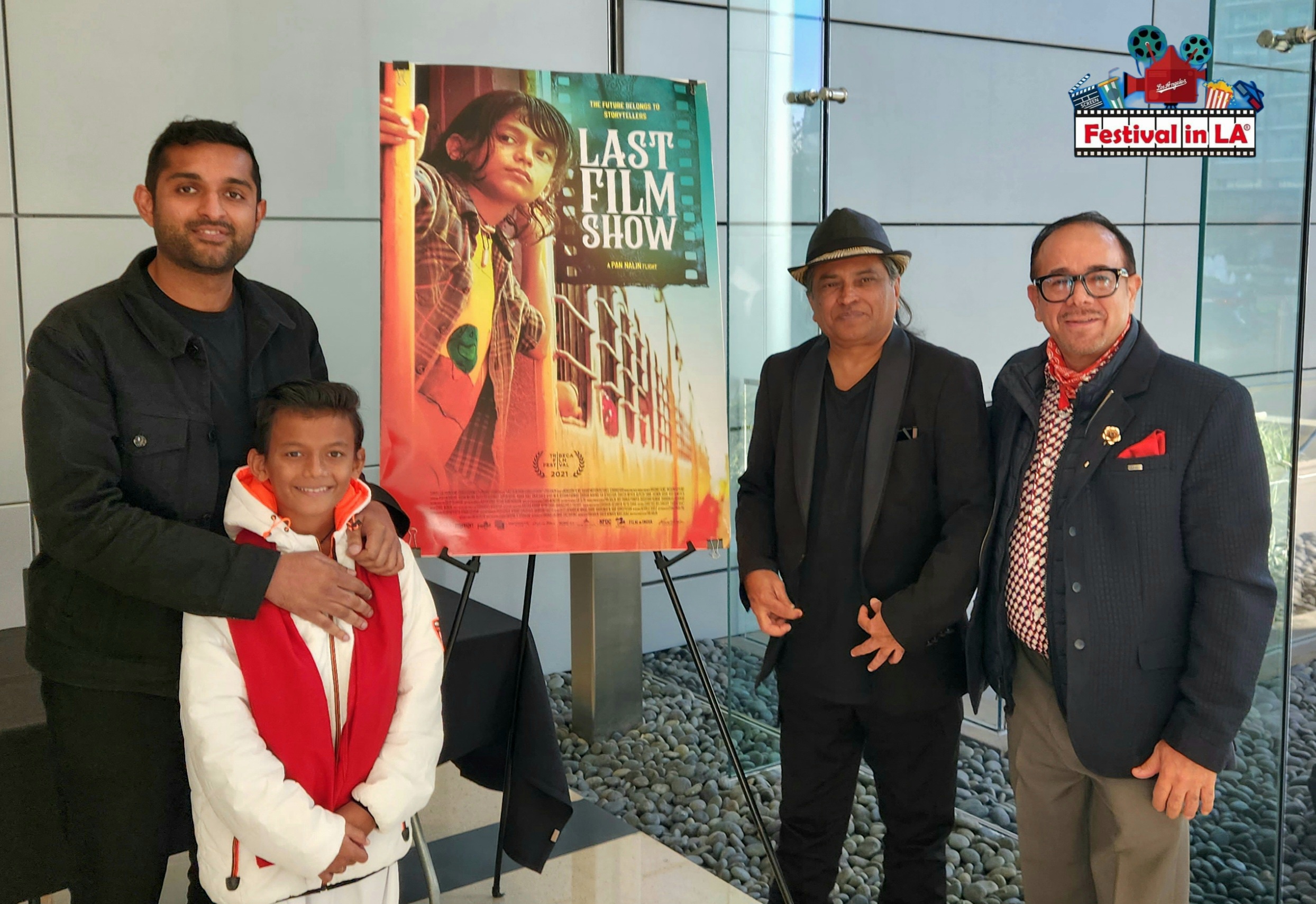
Last Film Show: Northern Indian Food & Marsala Films in a Children's Adventure

By José Alberto Hermosillo

“Last Film Show” is an unforgettable children’s adventure. It brilliantly combines Northern Indian food and classical Marsala cinema. This memorable adventure displays India’s untamed spirit to its fullest.

The award-winning Indian drama about aging and coming of age is seen through the eyes of a wondrous kid whose fascination with cinema extends beyond the walls of school and his family’s well-being. Samay is portrayed by newcomer Bhavin Rabari wonderfully and naturally believably.

Bhavin Rabari is Samay in “Last Film Show.” Photo: José Alberto Hermosillo, CAA (Creative Artists Agency), Century City, Los Angeles, CA. www.FestivalinLA ©2022

The film is set in the mid-1980s and unfolds organically and spontaneously, following a young cinema lover who skips school and sneaks into the local movie theater. He finds a way to get into the projectionist’s heart through his stomach with the delicious school meals his mother makes daily.

Bribing the projectionist with Marsala food is not the only trouble the kid gets into; Samay’s adventures inside the movie theater include stealing the film reels from the post office to build a projector and show those fantastic films to other kids without electricity. 

Short of understanding the transition from film to digital projection, the kid witnesses it and sees how the projectionist loses his job to a computer-literate geek who can manage the entire movie theater with a laptop. 

Behind the camera is the artistry of renowned Indian director/writer/producer Pan Nalin (“Samsara,” “Angry Indian Goddess”). According to him, his film opens the viewer’s mind to the cultural complexity of other parts of the world.

Director Pan Nalin & actor Bhavin Rabari “Last Film Show.” Photo: José Alberto Hermosillo, CAA (Creative Artists Agency), Century City, Los Angeles, CA. www.FestivalinLA ©2022

Set in Northern India, near the border with Afghanistan, the movie emphasizes marginalized communities outside urban areas, child labor, survival, an unjust social structure, and economic conditions. For instance, people need to learn English to get equal opportunities in education and employment. Paradoxically, the ones who master English leave their communities as soon as possible.

The film contains well-selected clips from classic Indian cinema. Some Bollywood movies have become classics, while others are action-packed thrillers that entertain the masses. People in those movies do not look natural, says the director. In his film, he intends to be as realistic as possible by
 exposing people as they are and how they interact in their communities.

Regarding the question I asked in the Q&A about the combination of food and movies, Mr. Nalin answers cleverly, “The way to people’s hearts is through their stomachs.” He remembers his childhood by saying that his mother was a great cook. Additionally, Marsala films love food and movies because these elements draw people back to their roots in delicious, authentic food made with local, vegan products.

Inspired by the CinemaScope of the 1950s and 60s, talented cinematographer Swapnil S. Sonawane (“Newton” and “Dhappa”) captures perfect lighting to enhance the colors, giving the film a dazzling look. 

The filmmakers sought picturesque locations and used a vibrant color palette, multichromatic sets, lavish costumes, and shiny jewelry. Everything had to be filmed on camera, not in post-production, to reflect the country’s authenticity.

Director Pan Nalin centered his film on the life of a person he knew from the region. The more complicated part was to bring the producers to start production. If a studio does not back you, he recommends organizing a team to raise the money to produce the movie with other close friends, doctors, or family members who may pitch in to complete an acceptable production. “If you’re scared, you’re dead,” he said. Because it is hard to make an independent film in India or anywhere, he was lucky to have investors from France and the United States to complete the movie.

Casting the kid was challenging. While looking for a professional child actor, the famous Indian casting director Dilip Shankar (Ang Lee’s “The Life of Pi” and Wes Anderson’s “The Darjeeling Limited”) went to the
Gujarati community. He found a confident kid named Bhavin Rabari, the son of a bus driver. The kid’s family belongs to a tribe outside the “caste system” of other communities. The people there feel proud of their roots, where they came from, and of the opportunities they have to accomplish their dreams. For Bhavin Rabari, the first movie he had ever seen in a cinema theater was his movie.

Last Film Show
Producer Dheer Momaya, Child actor Bhavin Rabari, director Pan Nalin, “Last Film Show.” Photo: José Alberto Hermosillo, CAA (Creative Artists Agency), Century City, Los Angeles, CA. FestivalinLA ©2022

“Last Film Show” is spoken in Gujarati with some English dialogue. The movie has been selected as India’s entry for Best International Feature Film at the 95th Academy Awards. It has been shortlisted - beating the Netflix mega-production “RRR,” also the front-runner to win Best Original Song with “Naatu Naatu.”

The director is surprised that his film is receiving widespread international recognition, and he is happy to have his movie seen by a broader audience on streaming platforms. Still, he recommends the theatrical experience because that is how he fell in love with the film. 

This crowd-pleasing Indian/French co-production premiered at the Tribeca Film Festival in New York, where it won the audience award. Since then, “Last Film Show” has become an international hit.

LAST FILM SHOW (Chhello Show) Official Trailer

“Last Film Show” Indian Child Actor Talks About His Experience Making the Film

Producer Dheer Momaya, Child actor Bhavin Rabari, director Pan Nalin, “Last Film Show,” and film critic José Alberto Hermosillo, CAA (Creative Artists Agency), Century City, Los Angeles, CA. FestivalinLA ©2022

Child actor Bhavin Rabari is Samay in “Last Film Show” and film critic José A. Hermosillo, CAA (Creative Artists Agency), Century City, Los Angeles, CA. FestivalinLA ©2022


Related Articles:
Three Thousand Years of Longing, George Miller’s Lavish Genie Tale 
IF YOU ARE READING FROM A MOBILE DEVICE, CLICK: view web version FOR OTHER COOL FEATURES SUCH AS TRANSLATE POWERED BY GOOGLE, AN INTERACTIVE FILM FESTIVAL CALENDAR, AND MORE.

Festival in LA ©2022