Thursday, November 18, 2021

Olga: The Ukrainian Gymnast Who Represented Switzerland at the European Championships

By José Alberto Hermosillo
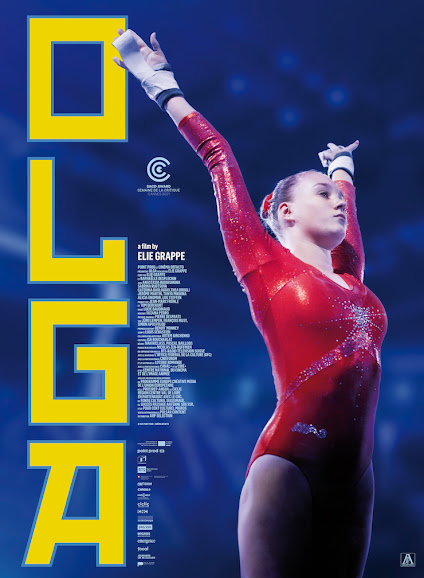
COLCOA REVIEW: “Olga” is a realistic and captivating dramatization of a Ukrainian gymnast who struggles to achieve her dreams in and outside her country.

The Swiss/French co-production is a fascinating and honest portrait of the world of gymnastics and what athletes must do to participate in international competitions. Young female athletes undergo intense “military” training conjoined with a tumultuous external political environment, which affects their mental health and well-being. 
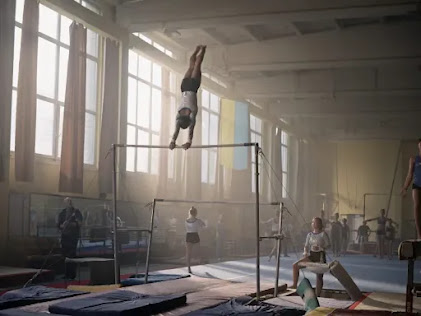

Gymnast-turned-actress Anastasia Budiashkina is a true revelation. 

Olga, a 15-year-old Ukrainian gymnast who was exiled to Switzerland, works tirelessly to secure a place at the country’s National Sports Center and compete at the European championships.
The story progresses from her specific physical training to the external political conflict afflicting her homeland, which touches Olga’s psychological stability.

Her mom is a notorious journalist who worked to uncover corruption cases and to expose President Yanukovych’s refusal to sign the free trade agreement with the European Union. During Ukraine’s Euromaidan of 2013, Olga’s mother became a victim of political persecution, repression, and brutality.

Witnessing the riots in Switzerland, Olga suffers anxiety and excessive psychological damage that affects her performance. Far from her Ukrainian teammates, she can still connect with them through a smartphone, where she catches a glimpse of what is happening with her mom.

The film simultaneously depicts the girl’s experience of the political crisis in her native land, her adolescent crisis, and the immigrant challenges in her social world.

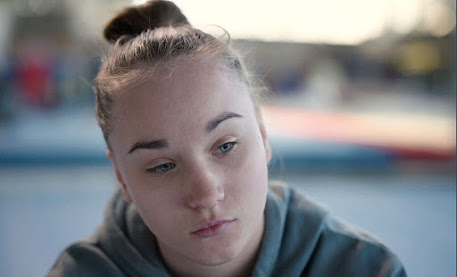
Actress Anastasia Budiashkina delivers Olga’s astonishing, raw, and faithful incarnation. Her strong body denotes solid gymnastic skills, conveyed by her expressive blue eyes, which flawlessly exhibit her character’s vulnerability.
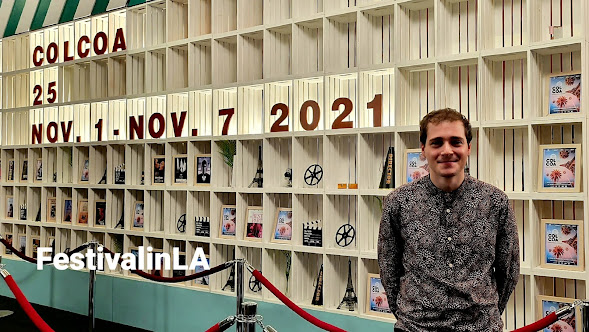
Elie Grappe, “Olga” director at COLCOA. Photo: José Alberto Hermosillo. Festival in LA ©2021

First-time French director Elie Grappe pulls off a compelling work. Fortunately for the director, project, and viewers, she is both a professional actor and athlete accustomed to competing in large-scale arenas.

In a related real-life story, the turmoil that affected the US gymnastics team at the Tokyo 2020 Olympic Games was psychological pressure, mental stress, and other external factors that physically undermined the athletes’ performances. As news of the American team’s challenges spread worldwide, the timing of “Olga’s” release could not be better, serving as an inspirational beacon for thousands of young athletes who dream of competing in the Olympics and can relate to Olga’s experience.

Elie Grappe gave the young actresses enough space to display their emotions, as he wanted to show their passion, desires, and true nature right from the beginning. The story focuses on a young girl with a strong body and an athletic complexion, ready for an international championship.

Elie Grappe tells the story authentically through functional, spacious settings, clearly intended to lend his first feature film a “documentary look” while creating dramatic moments in intimate settings.
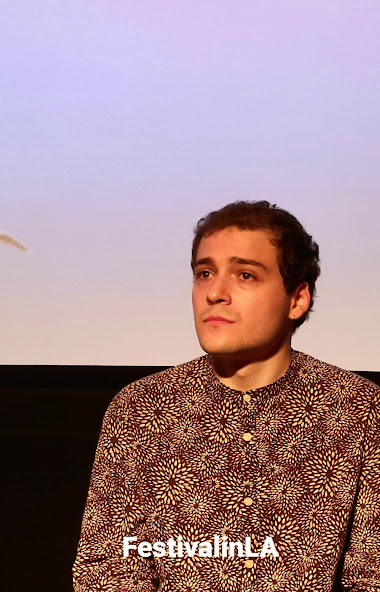
Elie Grappe, “Olga” director at COLCOA. 
Photo by José Alberto Hermosillo. Festival in LA ©2021

The director made the good work an essential part of the film to heighten the intensity of every scene, focusing on the athlete’s stress, training, failures, and accomplishments. He wanted to convey the main character’s anger and confrontation with the rest of the world through sound, acoustics, and vital musical tones. He thus bolsters the whole atmosphere by recording the participants’ training with dynamic microphones.

French director Elie Grappe emigrated to Switzerland at 17, and it took him 10 years to make “Olga.” 

The COVID-19 crisis, too, severely impacted the crew during the lockdown. When one of the members died, filming was suspended. After a year, they faced another challenge and returned to complete the movie. Evidently, the young actors had grown relatively quickly and no longer looked the same as before the pandemic.  

The editing slows down the action, and Olga’s failures are repetitive, leaving the audience wondering if she will succeed.

Selected as the Swiss entry for the Best International Feature Award at the 94th Academy Awards, “Olga” is the winner of the SACD Award at the Critics’ Week in Cannes 2021. It also won Best Picture at the Brussels International Film Festival and Best Feature at the Hamburg International Film Festival.

“Olga” is about the struggles and choices a gymnast has to make to become somebody, whether she wants to be a Swiss champion or a Ukrainian patriot. 
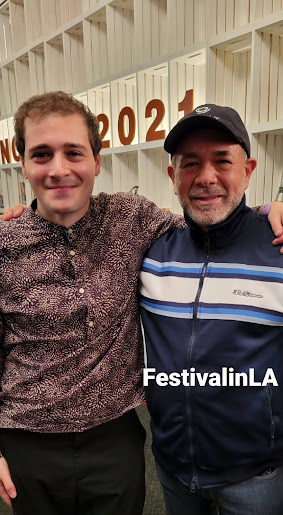
Elie Grappe, “Olga” director at COLCOA, and film critic José Alberto Hermosillo. Festival in LA ©2021

OLGA, French trailer

Related Articles:  

IF YOU ARE READING FROM A MOBILE DEVICE, CLICK: view web version FOR OTHER COOL FEATURES SUCH AS TRANSLATE POWERED BY GOOGLE, AN INTERACTIVE FILM FESTIVAL CALENDAR, AND MORE AWESOME ARTICLES.

 Festival in LA ©2021

Monday, November 1, 2021

Under the Volcano: The Golden Era of a Recording Studio of the Caribbean

By José Alberto Hermosillo 


“Under the Volcano” is the work of a genius, musically speaking! It is a highly creative, entertaining, and invaluable documentary worth every bit!

This recently produced broadcast contains iconic material considered a legacy for future generations. It depicts the close collaboration between the Beatles’ music producer, George Martin, and some of the most famous and transcendent rock and pop musicians of the 1970s and 1980s, right amid the seismic reverberations of the Soufrière Hills Volcano.

Sir George Martin in the documentary Under the Volcano.

The well-crafted documentary has impressive archival footage of the people who worked in the recording studio on that mysterious island in the middle of nowhere.

Montserrat, also known as the hidden gem of the Caribbean, is a pear-shaped island paradise in the Lesser Antilles chain. In 1976, the legendary music producer purchased land on the island. George bought some of the best and most advanced equipment, including an enormous mixing console, to build the Air Studios. Looking for perfection and the finest quality in sound recording, George also brought in some of the most knowledgeable technicians from London, Florida, and New York.

 Under the Volcano. Stewart Copeland, from The Police, at the console.

By creating a music recording studio on the island, George wanted to connect renowned talent with nature. George thought the quality of the music would improve enormously if he took the musicians out of their urban, glamorous, and vicious environment and placed them in an isolated location where they could focus on their art.

Being locked up in the city’s studios made artists lose perspective. On the other hand, walking out of the island’s studio for a nice beach hike, a swimming pool splash, or having drinks with the locals stimulated their creativity. They merged with the people and their festivities and listened to the Caribbean musical roots, which influenced artists’ new sounds - subsequently, their greatest hits.


During the 1980s, the recordings reached the top of the charts, and more groups were drawn to work on the island of Montserrat. The band “Earth, Wind and Fire” recorded a double album there. Paradoxically, even the housekeepers and gardeners on the property were musicians, too. 

The 1980s will be remembered as the Golden Era of Recording Studios. In the documentary, well-known musicians talk freely about their experiences recording their greatest hits on that island where distractions were nonexistent, and creativity was a must.

Among other remarkable bands and solo performers who left indelible memories by recording their greatest hits on the island were America, Ultrabox, The Police, Duran Duran, The Rolling Stones, Sting, Annie Lexington, Dave Stewart, Sheena Easton, Paul McCartney, Steve Wonder, and Elton John.

Under the Volcano, The Police.

“A record producer is not like a film producer, and a record producer is much more like a film director.” Said Gerry Beckley from the band America.

“Under the Volcano,” directed by Gracie Otto (“The Last Impresario”), is a documentary that features well-staged interviews and plenty of intimate, previously unseen footage—personal photos, newspapers, and articles from the vast majority of the constellation of Stars parading in such a hidden paradise. 

After the terrifying images of the volcano’s 1995 eruption, nearly all the inhabitants were displaced. The paradox is that the place’s success, which holds the birth of the greatest hits of those famous musicians, was confronted by the relentless forces of nature.

The enormous amount of information presented at the beginning of the documentary contrasts with the elongated, decadent scenes leading up to its big finale.

The documentary gained mixed reviews for political and social reasons. 

Under the Volcano

“Under the Volcano” is an excellent source of information for the general public. The accomplished documentary is a great source of inspiration for musicians, recording engineers, music enthusiasts, and historians who can learn more about a hidden place in the world where the greatest hits and iconic albums were created.

Viewing “Under the Volcano” means delving deeply into the creative process of music conception.

 UNDER THE VOLCANO Official trailer

Related Articles: 

IF YOU ARE READING FROM A MOBILE DEVICE, CLICK: view web version FOR OTHER COOL FEATURES SUCH AS TRANSLATE POWERED BY GOOGLE, AN INTERACTIVE FILM FESTIVAL CALENDAR, AND MORE AWESOME ARTICLES.

 Festival in LA ©2021

Monday, October 11, 2021

COLCOA CELEBRATES 25 YEARS OF FRENCH FILMS IN LOS ANGELES

By José Alberto Hermosillo


Related Articles:  

IF YOU ARE READING FROM A MOBILE DEVICE, CLICK: view web version FOR OTHER COOL FEATURES SUCH AS TRANSLATE POWERED BY GOOGLE, AN INTERACTIVE FILM FESTIVAL CALENDAR, AND MORE AWESOME ARTICLES.

Festival in LA © 2021