Showing posts with label European Cinema. Show all posts

Tuesday, September 12, 2023

Passages: A Very Sui Generis Love Affair in Paris

By José Alberto Hermosillo


In the era of diversity and inclusion, “Passages” is a successful attempt by Queer Cinema to crossover into mainstream media. 

“Passages” is a refreshing and sophisticated new French/German Queer drama attempting to explore the laws of attraction, arousal, behavior, and human sexuality without bounds in this modern love story.

The eternal triangle scenario centers naturally on a same-sex couple struggling over an infidelity one of them had with a woman. The problem is that the suitor likes exploring his bisexuality further with the opposite sex and wants to keep it that way, but his heart is attached to his husband.


Triggered by his husband’s rejection, self-centered German director Tomas Freiburg (Franz Rogowski) falls into an extramarital steamy relationship with Agathe (Adèle Exarchopoulos), an elementary school teacher, who falls for him carelessly. 


In a short period, Tomas’s intellectual husband, Martin (Ben Whishaw), witnesses how Tomas is going into self-destruction mode and how his erratic conduct affects other people’s lives, including their fifteen-year marriage.


Franz Rogowski as Tomas is extraordinary. He plays the perfect antihero of the story as an openly gay film director with enormous emotional baggage.


Rogowski’s charming and even cynical smile and profound gaze convey the right emotions to captivate his audience, elements that make the actor continue to grow, as evident in his previous performances in “Transit,” “Undine,” “Great Freedom,” and the upcoming “Disco Boy.” With enormous confidence, he conquers the screen as one of the greatest European actors of our time.


His counterpart, British actor Ben Whishaw, is terrific as the dedicated and betrayed husband. His character, Martin, is a low-key graphic artist and owner of a high-end print shop. In the film, his break-up does not prevent him from fooling around with other guys in their social circle. 


Whishaw is a chameleonic actor who has performed excellently for almost three decades. His most iconic roles were in the 2006 “Perfume: The Story of a Murder,” alongside Dustin Hoffman, and in the British period film “Bright Star.” More recently, he worked in “Paddington,” “Skyfall,” “No Time to Die,” and the Award-winning feminist piece “Women Talking” as the raconteur of the women’s struggle.
 
The questionable concubine Agathe is exquisite, confident, and feminine with traditional French parents. She is a practical woman who does not give importance to her new partner’s lifestyle. Agathe is played by the always sumptuous Adèle Exarchopoulos (“Blue is the Warmest Color,” “Les anarchistes,” and “The White Crow”).


Film director Ira Sachs (“Frankie,” “Love is Strange”) ’s fierce and meticulous method of directing actors demonstrates her ability to get the most out of them professionally. In her work, she introduced a new kind of “Teorema,” referring to the type of sexuality presented in the 1968 Pier Paolo Pasolini’s Italian Cult Classic “Theorem.” 


“Passages” has intricate relationships and a playful tone similar to Bernardo Bertolucci’s “Dreamers.” The modernity of Nadav Lapid’s storytelling in “Synonyms” elevates Sachs’s work to a new and profound level of understanding human behavior.
The luxurious cinematography enhances the sharp colors, and close-up imagery focuses on the subjects, a responsibility of talented Josée Deshaies (“Lamb,” “Saint Laurent,” “Curling”). It has an effervescent atmosphere and creates an uneasy feeling of wonder and anxiety in the spectator.


A big shout-out to the costume department for showing French fashion on a large scale. Every character is dressed in a way that reflects their personality, leaving no doubt about who is who in the story.
 
The set design department did a fabulous job choosing those unknown locations in Paris. The interior design, furniture, and accessories are superbly colored. On the couple’s living room wall hangs the iconic poster for the 2019 Emmy-nominated LGBTQ documentary The Circus of Books by Rachel Mason. It is festive and refers to Tomas’ passion for fine print and the couple’s happiness when they were together.


“Passages” is a freshly made, entirely original film full of surprises, making it impossible to know where every scene will take you next.


Besides how strident and sexually explicit y the film can be, there is a time for reflection on the direction our society is taking. In times of solitude, moving on from a long-term relationship is complicated, especially when the people they trust and love are not supportive. Therefore, it is worth our time to watch one of the year’s best films, which features strong production values, impeccable direction, and terrific performances that convey emotion to the audience. 


IF YOU ARE READING FROM A MOBILE DEVICE, CLICK: view web version FOR OTHER COOL FEATURES SUCH AS TRANSLATE POWERED BY GOOGLE, AN INTERACTIVE FILM FESTIVAL CALENDAR, AND MORE AWESOME ARTICLES.

Festival in LA ©2023

Thursday, November 18, 2021

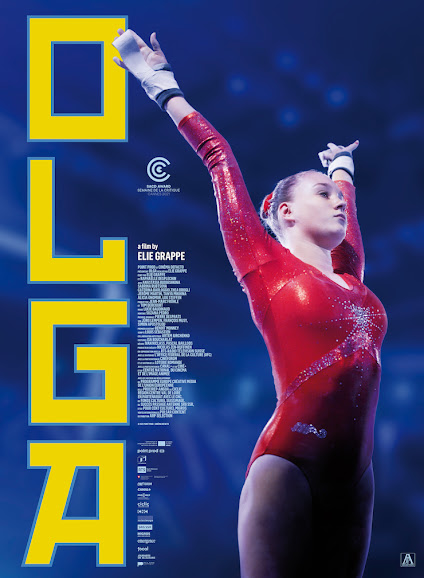
Olga: The Ukrainian Gymnast Who Represented Switzerland at the European Championships

By José Alberto Hermosillo

COLCOA REVIEW: “Olga” is a realistic and captivating dramatization of a Ukrainian gymnast who struggles to achieve her dreams in and outside her country.

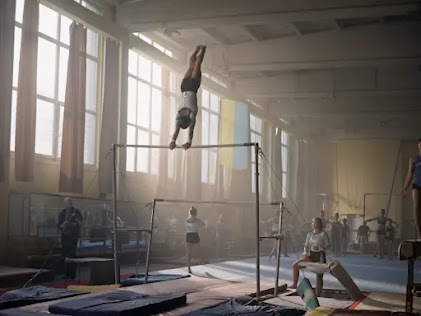
The Swiss/French co-production is a fascinating and honest portrait of the world of gymnastics and what athletes must do to participate in international competitions. Young female athletes undergo intense “military” training conjoined with a tumultuous external political environment, which affects their mental health and well-being. 


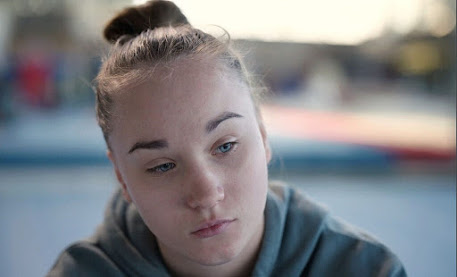
Gymnast-turned-actress Anastasia Budiashkina is a true revelation. 

Olga, a 15-year-old Ukrainian gymnast who was exiled to Switzerland, works tirelessly to secure a place at the country’s National Sports Center and compete at the European championships.

The story progresses from her specific physical training to the external political conflict afflicting her homeland, which touches Olga’s psychological stability.

Her mom is a notorious journalist who worked to uncover corruption cases and to expose President Yanukovych’s refusal to sign the free trade agreement with the European Union. During Ukraine’s Euromaidan of 2013, Olga’s mother became a victim of political persecution, repression, and brutality.

Witnessing the riots in Switzerland, Olga suffers anxiety and excessive psychological damage that affects her performance. Far from her Ukrainian teammates, she can still connect with them through a smartphone, where she catches a glimpse of what is happening with her mom.

The film simultaneously depicts the girl’s experience of the political crisis in her native land, her adolescent crisis, and the immigrant challenges in her social world.

Actress Anastasia Budiashkina delivers Olga’s astonishing, raw, and faithful incarnation. Her strong body denotes solid gymnastic skills, conveyed by her expressive blue eyes, which flawlessly exhibit her character’s vulnerability.

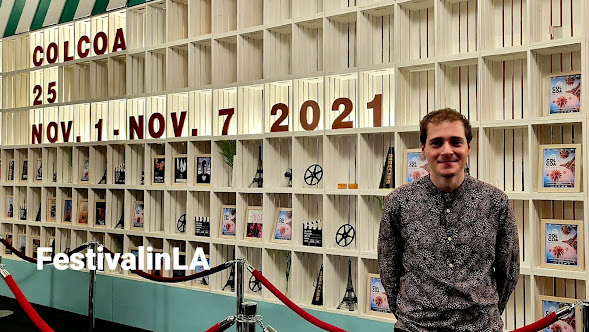
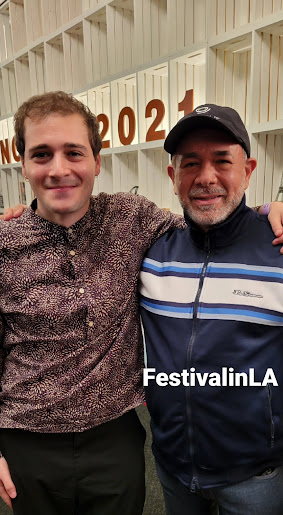
Elie Grappe, “Olga” director at COLCOA. Photo: José Alberto Hermosillo. Festival in LA ©2021

First-time French director Elie Grappe pulls off a compelling work. Fortunately for the director, project, and viewers, she is both a professional actor and athlete accustomed to competing in large-scale arenas.

In a related real-life story, the turmoil that affected the US gymnastics team at the Tokyo 2020 Olympic Games was psychological pressure, mental stress, and other external factors that physically undermined the athletes’ performances. As news of the American team’s challenges spread worldwide, the timing of “Olga’s” release could not be better, serving as an inspirational beacon for thousands of young athletes who dream of competing in the Olympics and can relate to Olga’s experience.

Elie Grappe gave the young actresses enough space to display their emotions, as he wanted to show their passion, desires, and true nature right from the beginning. The story focuses on a young girl with a strong body and an athletic complexion, ready for an international championship.

Elie Grappe tells the story authentically through functional, spacious settings, clearly intended to lend his first feature film a “documentary look” while creating dramatic moments in intimate settings.

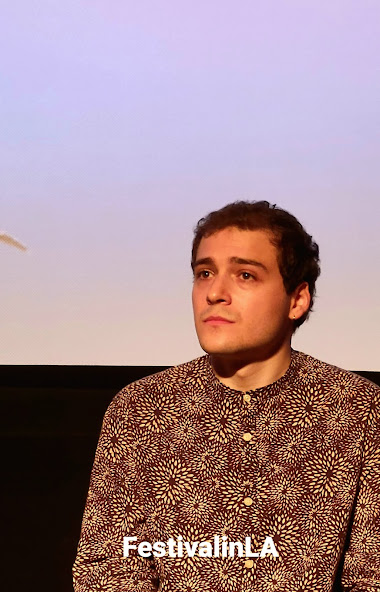
Elie Grappe, “Olga” director at COLCOA. 
Photo by José Alberto Hermosillo. Festival in LA ©2021

The director made the good work an essential part of the film to heighten the intensity of every scene, focusing on the athlete’s stress, training, failures, and accomplishments. He wanted to convey the main character’s anger and confrontation with the rest of the world through sound, acoustics, and vital musical tones. He thus bolsters the whole atmosphere by recording the participants’ training with dynamic microphones.

French director Elie Grappe emigrated to Switzerland at 17, and it took him 10 years to make “Olga.” 

The COVID-19 crisis, too, severely impacted the crew during the lockdown. When one of the members died, filming was suspended. After a year, they faced another challenge and returned to complete the movie. Evidently, the young actors had grown relatively quickly and no longer looked the same as before the pandemic.  

The editing slows down the action, and Olga’s failures are repetitive, leaving the audience wondering if she will succeed.

Selected as the Swiss entry for the Best International Feature Award at the 94th Academy Awards, “Olga” is the winner of the SACD Award at the Critics’ Week in Cannes 2021. It also won Best Picture at the Brussels International Film Festival and Best Feature at the Hamburg International Film Festival.

“Olga” is about the struggles and choices a gymnast has to make to become somebody, whether she wants to be a Swiss champion or a Ukrainian patriot. 

Elie Grappe, “Olga” director at COLCOA, and film critic José Alberto Hermosillo. Festival in LA ©2021

OLGA, French trailer

Related Articles:  

IF YOU ARE READING FROM A MOBILE DEVICE, CLICK: view web version FOR OTHER COOL FEATURES SUCH AS TRANSLATE POWERED BY GOOGLE, AN INTERACTIVE FILM FESTIVAL CALENDAR, AND MORE AWESOME ARTICLES.
 Festival in LA ©2021