Friday, April 14, 2023

Joyland: A Cinematic Rejoice from Pakistan

By José Alberto Hermosillo

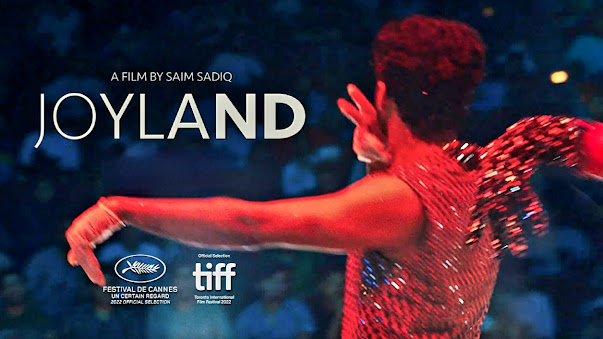
“Joyland” is a poignant allegory of love, despair, and melancholy—an achievement in Pakistani cinema.


“Joyland” challenges consciences on many levels, serving as both a powerful coming-of-age story and a reflection of a society that denies essential rights, such as inclusion, free speech, and equal opportunities for everyone, including those who think outside the box. In life, we often generalize and stereotype others, but instead, we should analyze and evaluate each person as a vital part of the community.


The film focuses on Haider Rana (Ali Junejo) and his conservative family. He lives with his wife, Mumtaz (Rasti Farooq), his father, mother, and his older brother’s family in Lahore, Pakistan.


Haider is an unemployed, hardworking, and shy man who lands a job as a backup dancer in a Bollywood-style burlesque show. Soon, the helpful and naïve man falls for Biba (Alina Khan), a sparkling trans woman who hosts a show at a nearby theater. As circumstances grow more complicated, Haider must navigate his double life carefully.


Biba shares a simple but meaningful joke with Haider: “The chicken and the mosquito shared a kiss. Then, the mosquito died of bird flu... the chicken died of dengue.” She then explains: “Because falling in love means death.” The joke highlights two main, opposing characters: the religious married man and the openly gay transgender person seeking freedom in a conservative society with strict laws.


The vibrant production centers on three distinct and memorable characters: Haider, Mumtaz, and Biba.


For Haider, his family is as crucial as the show’s success. He takes Biba’s safety seriously and cares about his family’s well-being, but balancing everything in real life isn’t easy.


Mumtaz is emotionally fragile. She wants to be pregnant but doubts her husband’s job because of his frequent absences.


Biba’s multidimensional character is neither sugar-coated nor does she pretend to be cute. She is an energetic, confident, and trustworthy trans woman who aspires to emigrate to Germany. Her honesty causes her to reject those who care for her, including Haider. Alina Khan’s performance is as impressive as Daniela Vega’s in the award-winning Chilean film “A Fantastic Woman.”


What is more remarkable about this moving production is that, despite featuring extraordinary actors, it was their first experience acting in films.


 Saim Sadiq, "Joyland." Photo by José Alberto Hermosillo. Copyright © FestivalinLA

First-time writer-director Saim Sadiq describes “Joyland” as a deeply personal project because he comes from a diverse, middle-class family that is also trying to climb the social ladder, much like the characters in his film. Still, he has to recognize that people in Pakistan live in a patriarchal society that imposes limits on progress, love, and desires.


Director Saim Sadiq created an honest and balanced script that consistently emphasizes the “trans” theme and social conflict, building a strong dramatic arc and an open ending. Politically, Saim acknowledges the influence of the extreme right wing in his country and admits that his work will likely upset many. He mentioned that after screening his controversial film in Pakistan, he didn’t expect everyone to stay and applaud. Still, he hoped his film would inspire people to enjoy it, reflect on it, and continue thinking about it.


The highly acclaimed Pakistani film transcends barriers of freedom and acceptance.


It won the Jury Award at Un Certain Regard, Cannes 2022. It also received Best International Film at the Independent Spirit Awards 2023 and Best Artistic Contribution at the Cairo International Film Festival in Egypt. The celebrated movie earned Best Ensemble at the Bangkok Film Festival and the Audience Award at the Valladolid International Film Festival in Spain.


“Joyland” was Pakistan’s submission for Best International Feature Film at the 95th Academy Awards and was one of the fifteen films shortlisted.


The unexpected twists of “Joyland” take us to places we’ve never experienced before. The film’s vibrant urban settings, colors, and textures, combined with compelling storytelling, elevate the cinematic experience and draw viewers into the story.


More importantly, it is crucial to highlight the vibrant Pakistani youth who work hard and aspire to explore new horizons beyond their family’s boundaries, free from social restraints.


In “Joyland,” every character genuinely seeks acceptance, love, and respect, while audiences witness the struggle, beauty, and diversity of Pakistani society and other communities worldwide.

JOYLAND | OFFICIAL TRAILER

Violette: When Women Dare to Write  

IF YOU ARE READING FROM A MOBILE DEVICE, CLICK: View web version FOR OTHER COOL FEATURES SUCH AS TRANSLATE POWERED BY GOOGLE, AN INTERACTIVE FILM FESTIVAL CALENDAR, AND MORE AWESOME ARTICLES.

Festival in LA ©2023

Thursday, April 13, 2023

War Sailor: A Reflection on Norway’s Entanglement in WWII

By José Alberto Hermosillo  


War Sailor” is a revealing, gripping, and insightful depiction of the forgotten Norwegian sailors and their women who endured the atrocities of World War II.


Until now, War Sailor,” known as “Krigsseileren,” has been the most expensive production ever made in Norway. The film attempts to set history right by presenting the sailors’ struggle, which many consider heroic. Still, people in charge see them as a public burden, criminals and deserters who deserve to be forgotten and dismissed without the benefits of the law for their service.


“War Sailor” lobby at a Beverly Hills screening. Photo by José Alberto Hermosillo. Copyright © Festival in LA


During WWII, over 30,000 Norwegian and 10,000 American sailors took part in the war on the Scandinavian Peninsula and in the North Sea.


War Sailor” courageously explores the straightforward participation of those sailors who fought in those epic battles and the devastating effects on them and their families back home.


The film links the sailors’ past pain to their present, showing how those traumatic experiences were inherited across generations.


The story centers on Alfred, played by Kristoffer Joner (The Wave,” “The Revenant”), a working-class sailor from Bergen who is the head of his family. He is close to his childhood friend Sigbjørn (Pål Sverre Hagen, “Kon Tiki”), and they have worked together on a merchant ship for years.


When WWII broke out, they found themselves fighting on the front lines wearing civilian clothes, unarmed, with a starving crew, after their merchant ship was attacked by German submarines. Their journey continues from being rescued to trying to rebuild their lives separately, and shows how their families suffer from their absence and the trauma of PTSD.


Marie Wilmann, “War Sailor.” Photo by José Alberto Hermosillo. Copyright © Festival in LA

Actor Marie Wilmann, who portrays Cecilia, Alfred’s wife, took her role in the film personally. Her parents and grandparents lived through the war years, and she felt what they endured. The effects of the war impacted women like her mother and grandmother.


Researching for this epic film was a massive undertaking. Norwegian writer/director Gunnar Vikene (Here is Harold”) based his original screenplay on true events, interviews, and numerous visits to museums and Norway’s National Archives. He then shifted his focus to explore the sailors’ emotional, physical, and financial struggles.


For this film, the director’s biggest influence was the contemporary, Oscar-winning short documentary “The White Helmets,” a gripping real-life chronicle of UN responders saving lives in Syria. Norwegians initially knew little about the significance of that war, but newly arrived Syrian immigrants helped educate locals about their harrowing experiences in their troubled homeland.


“War Sailor” vividly shows how war affects everyone in the community. Director of Photography Sturla Brandth Grøvlen (“Victoria,” “Another Round,” “Rams”) moved the camera intuitively. His exceptional close-ups of the actors’ eyes are as striking as his landscapes and ocean views.


At the Oslo premiere, some attendees opposed the truth and conflicted with the story. The filmmakers talked extensively with war veterans about how the war affected them and their families. Ironically, when they received a medal, they also received a bill for it. Additionally, Norwegians had to pay extra taxes on food and supplies. War sailors returned home with bills to pay, along with struggles with alcoholism and addiction to medications and other drugs. Norwegian veterans never received proper recognition or compensation for their service. Many sailors came from different countries, including the United States.


Pål Sverre Hegen & Marie Wilmann, “War Sailor.” Photo by José Alberto Hermosillo. Copyright © Festival in LA


According to the actors, producing the film during the pandemic was even more challenging and costly because some cast and crew members contracted COVID-19. War Sailor” is the most prominent Norwegian production shot in Malta, Germany, and Norway.


War Sailor” is Norway’s Best International Feature Film entry for the 95th Academy Awards. Now, it is streaming on Netflix as a three-episode miniseries. 


Pål Sverre Hegen & Marie Wilmann, “War Sailor.” Critc José Alberto Hermosillo. Copyright © Festival in LA

WAR SAILOR trailer

Violette, When Women Dare to Write  

IF YOU ARE READING FROM A MOBILE DEVICE, CLICK: view web version FOR OTHER COOL FEATURES SUCH AS TRANSLATE POWERED BY GOOGLE, AN INTERACTIVE FILM FESTIVAL CALENDAR, AND MORE AWESOME ARTICLES.

Festival in LA ©2023

Monday, April 3, 2023

Spinning Gold: The Man Behind Donna Summer, Village People, and KISS Greatest Hits

By José Alberto Hermosillo


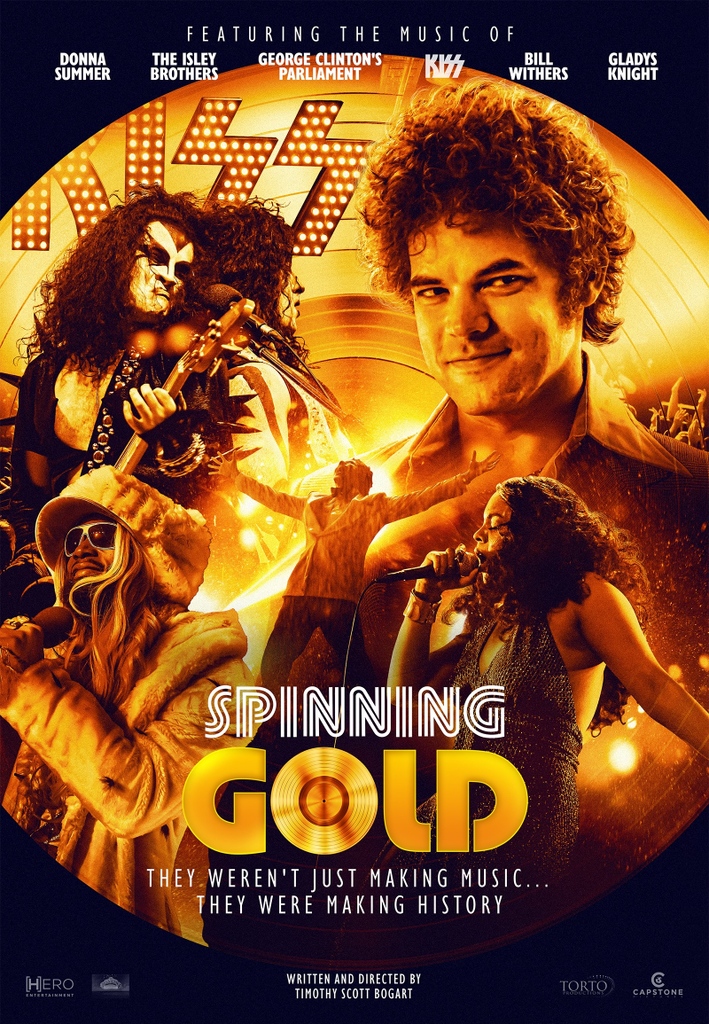
Relevant and freshly made, “Spinning Gold” tells the untold story of visionary record producer Neil Bogart, the man behind America’s biggest hits of the 1970s such as “Ain’t No Sunshine,” “Love to Love You, Baby,” “Hot Stuff,” “Last Dance,” “On the Radio,” “Midnight Train to Georgia,” “Lean on Me,” “YMCA,” and “Beth.”


Neil Bogart, known as “the star maker,” discovered and promoted some of the most iconic singers to stardom—Donna Summer, Gladys Knight, Bill Withers, The Isley Brothers, The Village People, and KISS.


KISS in “Spinning Gold.” Photo courtesy of Movie Platform.

The life of the visionary record producer hits the big screen in an insightful and nostalgic biopic, where viewers can see not only Neil’s personal life and his relationships with future stars, but also get dirt on the record industry. He was a hustler, a gambler, and addicted to heavy drugs. To pay for the engagement ring, Neil worked in a soft-porn movie. This shows how far he was willing to go. Without being judgmental, it was a time when people enjoyed life to the fullest with plenty of sex and drugs, just before the AIDS pandemic, the war on drugs, and corporate greed.


Neil had to navigate betrayals, payola violations, and lawsuits to establish Casablanca Records as the most successful independent recording company in American history. The competition with other studios was intense, mainly against Universal, Warner Bros., Motown, and Arista. 

Timothy Scott Bogart, “Spinning Gold.” Photo by José Hermosillo. Copyright © Festival in LA 


According to director and producer Timothy Scott Bogart, everything the movie depicts, including Neil’s issues with the Jewish, Italian, and Black mobs, was real. 


Timothy did not focus on specific moments in his father’s life but instead emphasized the chronology of the music. Every song Neil Bogart produced at Casablanca Records carries a compelling narrative because the rhythms from 1974 to 1977 build toward the drama’s climax, avoiding an episodic structure.


In “Spinning Gold,” Timothy Scott Bogart accurately captures Neil’s essence and positivity, advancing the story as his father did throughout his life, including producing each song and facing challenges such as going to Berlin to get Donna Summer.


Timothy Scott Bogart wrote the lines with musicality and freedom. He allowed the script to become something more. The story is told through costumes, makeup, set design, and mainly music. He aimed to make a “musical movie,” not “a movie with music” in it. Timothy’s insight was to realize how scared his father was at every stage of his professional and personal life.


Timothy aimed to pay visual homage to the era with neon, electric, and highly colorful images, costumes, and sets. The extras in the film were professional dancers who were easy to keep in frame.


Tayla Parx as Donna Summer in “Spinning Gold.” Photo courtesy of Movie Platform.


In 1999, he pitched the project to Paramount, and even Justin Timberlake was attached to play Neil Bogart at one point.


The film’s casting can be questionable because fans remember their idols at the peak of their careers after those diamonds were polished. Actress and singer Tayka Paxs has the confidence, innocence, and powerful voice to portray Donna Summer, not just someone who looks like her. Similarly, George Clinton’s case is comparable because rapper Wiz Khalifa is playing the legendary singer and original performer. Other actors were comedians capable of delivering the performance.


The director states that in his movie, he did not want someone impersonating another person but wanted genuine acting. Following in his father’s footsteps, Timothy is always fascinated by discovering new artists. 


Jeremy Jordan as Neil Bogard, “Spinning Gold.” Photo courtesy of Movie Platform.


Two months before the production, he went to Broadway and met Jeremy Jordan, who could captivate the audience with his charisma and musical talent. In “Spinning Gold,” Jeremy Jordan delivers a great performance, confidently portraying the independent record producer Neil Bogart.


The sound quality of “Spinning Gold” is excellent, and the soundtrack is detailed. The original songs were not simply remastered; they were re-recorded with new voices. They dedicated a lot of time to designing the film’s sound and mixing different tracks.


To obtain rights and access to such important songs, in 2009 Timothy Scott Bogart presented the film to record companies as an independent project. He secured lower rates for the entire song catalog, thereby avoiding the need for “needle drop” rights for 20-second song clips. That was not the case with “Spinning Gold.”


Donna Summer - Last Dance (Academy Awards,1978)

Suppose they have already secured the rights to those timeless hits. Why not recreate some of the most iconic moments associated with them, or at least mention those specific events, such as Donna Summer performing the award-winning song “Last Dance” at the Oscars, the crown jewel of the golden era of disco?


Long before the concepts of inclusion and diversity gained prominence, the independent record label Casablanca had African Americans, Jewish, and white people working together to achieve their core goal: bringing the best artists, composers, and theme songs to the masses.


In “Spinning Gold,” the vibrant musical montages add style to the film but need to be more than enough to balance the extended-family melodrama. The audience craves music, awards, and memorabilia from the entertainment industry. In other words, less drug use and more immersive creativity from the visionary artist and record producer who transcended his era to influence today’s music industry.


Timothy Scott Bogart and film critic José Hermosillo. Copyright © Festival in LA


Related Articles: 
Mrs. Harris Goes to Paris, The British Cleaning Lady to the Dior House

IF YOU ARE READING FROM A MOBILE DEVICE, CLICK: view web version FOR OTHER COOL FEATURES SUCH AS TRANSLATE POWERED BY GOOGLE, AN INTERACTIVE FILM FESTIVAL CALENDAR, AND MORE.

Festival in LA ©2023