Saturday, November 20, 2021

Drunken Birds: Paradox and Poetry in a Canadian Immigration Drama

By José Alberto Hermosillo 


Stunningly photographed and well-executed, “Drunken Birds” reveals the beliefs, actions, and passions of its three uniquely opposite characters with poetic regard across Canada and Mexico.

“Drunken Birds” centers its narrative on love, abandonment, and coming-of-age memories. Divided into three acts, like “Days of Heaven,” “Amores Perros,” and “Magnolia,” the Canadian production offers a compelling dramatization not far from reality. 

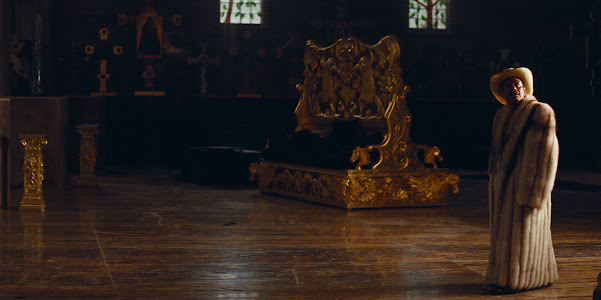
Inspired by seasonal migrant workers in Canada, the film opens with a young man arriving at an apartment complex in Montréal, then shifts to a flashback in Mexico, where it shows a mansion with white tigers and other abandoned, unrestrained animals. Then, a portrait of a man who, more than a patriarch, is a drug lord. He is spending time in prison because someone betrayed him.

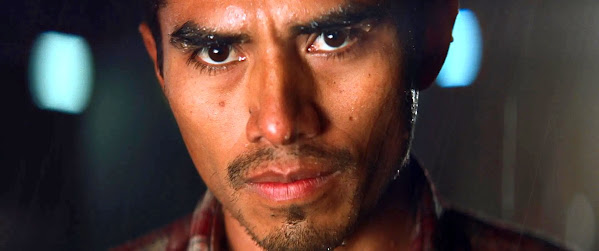
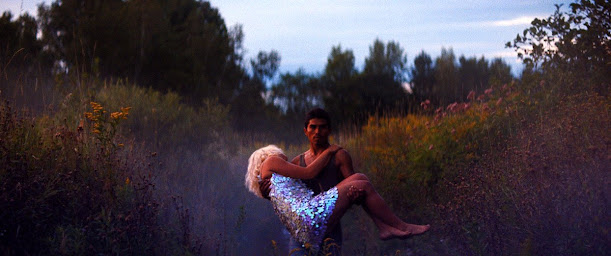
The place holds a secret: a love triangle in which Willi (Jorge Antonio Guerrero) falls for Narco’s wife, Marlena (Yoshira Escárrega). Fearing for their lives, the young lovers flee to Canada, each taking a different route.

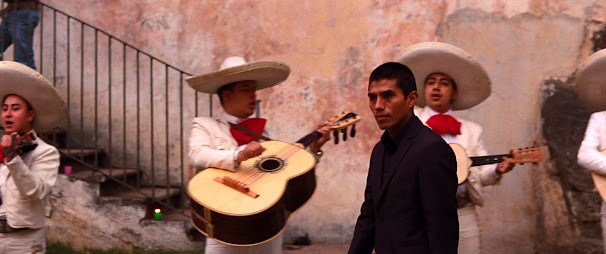
At the Ferme, Vinet – one of the oldest agricultural centers outside Quebec – Willi, along with other seasonal workers, learns the rules and responsibilities of harvesting lettuce. Four years pass, and Willi still misses Marlena, the love of his life.


It is hard to forget a loved one, even in a tranquil oasis.


After his breakthrough performance as Fermín opposite Yalitza Aparicio in the 2018 Academy Award-winning feature “Roma,” Jorge Antonio Guerrero takes the lead in this transcendental Canadian production, playing a Mexican immigrant worker in Canada.

The story takes a dramatic turn when Willi crosses paths with Julie (Hélène Florent), the neglected owner of a Canadian farmhouse, and her precocious teenage daughter, Lea (Marine Johnson), who only wants to have fun in the city.

The complications are straightforward when their past confronts their present. Although the conundrum keeps us wondering about possible resolutions. Everything becomes chaotic when Lea’s silence implicates Willi in wrongdoing.

The brief flashbacks diffuse the story’s emotional context, but the imagery’s beauty holds the narrative well.

“Drunken Birds” is also inspired by the 2011 Mexican Oscar entry “Miss Bala.” The script details the countries where the stories occur: Mexico, Canada, and China.

The well-balanced cinematography is Sara Mishara’s responsibility. She accomplishes cinematic glory by splendidly capturing the “magic hour” lighting. Sara shot the project “Old School” with a 35mm camera. The film’s grain gave her the convenience of plenty of depth in long shots and enhanced the clarity of close-ups, giving the movie the desired “dreamlike style.”

According to its director, Ivan Grbovic, “the characters of this intriguing triptych have distinct personalities with multidimensional layers that are not necessarily likable, although their behaviors are driven by love, desire or curiosity.” He added, “In this puzzle, all the pieces do not always fall together, but they are equally important.”

The independent production has the potential for greatness despite limited resources, although the “bad hombres”’ entrance to the hacienda in Mexico needed better choreography. There are plenty of other films in which the tension is in sync with a festive atmosphere, as seen in local productions such as Luis Puenzo’s “Old Gringo,” Baz Luhrmann’s “Romeo + Juliet,” and Ruy Guerra’s “Eréndida.”

“Drunken Birds,” winner of Best Cinematography at the Philadelphia Film Festival, premiered at the Toronto International Film Festival. It was selected as Canada’s Best International Feature Film entry for the 94th Academy Awards.

Willi’s noble heart compels him to help the needy, which is in his nature, even if it causes trouble with dramatic consequences in his immediate future. We have to remember that no one is guilty until proven otherwise, and no one is blameworthy until the truth comes out, but we are certainly not sure that will ever happen in fiction.


The filmmakers said that people in Canada associated the word “drunk” with love or joy, and birds with unity and migration. It is like a flock of birds moving together instinctively in complete freedom, just as we relate to the film’s characters’ stories effortlessly. 

The climax of “Drunken Birds” or “Les Oiseaux ivres” occurs when the three stores converge at a single point. At that precise moment, justice is most urgently needed, yet the irony is that we cannot always get what we want in life, and we must remember that the greatest enemy of all is silence.

Related Articles:

IF YOU ARE READING FROM A MOBILE DEVICE, CLICK: view web version FOR OTHER COOL FEATURES SUCH AS TRANSLATE POWERED BY GOOGLE, AN INTERACTIVE FILM FESTIVAL CALENDAR, AND MORE AWESOME ARTICLES.

 Festival in LA ©2021

Thursday, November 18, 2021

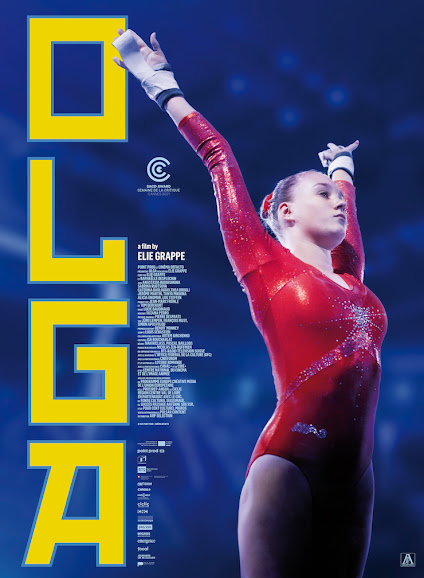
Olga: The Ukrainian Gymnast Who Represented Switzerland at the European Championships

By José Alberto Hermosillo

COLCOA REVIEW: “Olga” is a realistic and captivating dramatization of a Ukrainian gymnast who struggles to achieve her dreams in and outside her country.

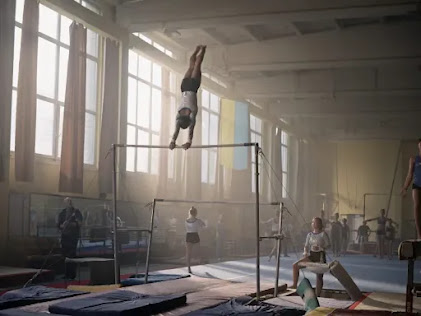
The Swiss/French co-production is a fascinating and honest portrait of the world of gymnastics and what athletes must do to participate in international competitions. Young female athletes undergo intense “military” training conjoined with a tumultuous external political environment, which affects their mental health and well-being. 


Gymnast-turned-actress Anastasia Budiashkina is a true revelation. 

Olga, a 15-year-old Ukrainian gymnast who was exiled to Switzerland, works tirelessly to secure a place at the country’s National Sports Center and compete at the European championships.

The story progresses from her specific physical training to the external political conflict afflicting her homeland, which touches Olga’s psychological stability.

Her mom is a notorious journalist who worked to uncover corruption cases and to expose President Yanukovych’s refusal to sign the free trade agreement with the European Union. During Ukraine’s Euromaidan of 2013, Olga’s mother became a victim of political persecution, repression, and brutality.

Witnessing the riots in Switzerland, Olga suffers anxiety and excessive psychological damage that affects her performance. Far from her Ukrainian teammates, she can still connect with them through a smartphone, where she catches a glimpse of what is happening with her mom.

The film simultaneously depicts the girl’s experience of the political crisis in her native land, her adolescent crisis, and the immigrant challenges in her social world.

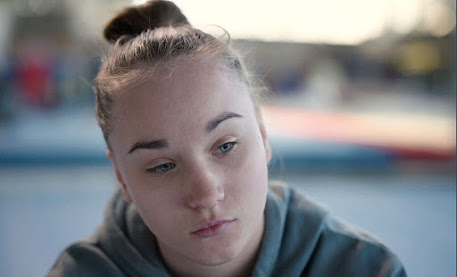
Actress Anastasia Budiashkina delivers Olga’s astonishing, raw, and faithful incarnation. Her strong body denotes solid gymnastic skills, conveyed by her expressive blue eyes, which flawlessly exhibit her character’s vulnerability.

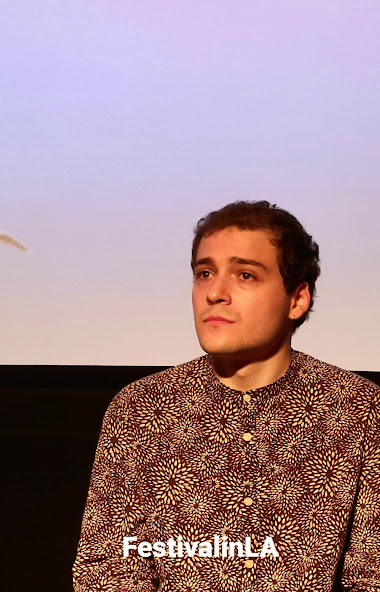
Elie Grappe, “Olga” director at COLCOA. Photo: José Alberto Hermosillo. Festival in LA ©2021

First-time French director Elie Grappe pulls off a compelling work. Fortunately for the director, project, and viewers, she is both a professional actor and athlete accustomed to competing in large-scale arenas.

In a related real-life story, the turmoil that affected the US gymnastics team at the Tokyo 2020 Olympic Games was psychological pressure, mental stress, and other external factors that physically undermined the athletes’ performances. As news of the American team’s challenges spread worldwide, the timing of “Olga’s” release could not be better, serving as an inspirational beacon for thousands of young athletes who dream of competing in the Olympics and can relate to Olga’s experience.

Elie Grappe gave the young actresses enough space to display their emotions, as he wanted to show their passion, desires, and true nature right from the beginning. The story focuses on a young girl with a strong body and an athletic complexion, ready for an international championship.

Elie Grappe tells the story authentically through functional, spacious settings, clearly intended to lend his first feature film a “documentary look” while creating dramatic moments in intimate settings.

Elie Grappe, “Olga” director at COLCOA. 
Photo by José Alberto Hermosillo. Festival in LA ©2021

The director made the good work an essential part of the film to heighten the intensity of every scene, focusing on the athlete’s stress, training, failures, and accomplishments. He wanted to convey the main character’s anger and confrontation with the rest of the world through sound, acoustics, and vital musical tones. He thus bolsters the whole atmosphere by recording the participants’ training with dynamic microphones.

French director Elie Grappe emigrated to Switzerland at 17, and it took him 10 years to make “Olga.” 

The COVID-19 crisis, too, severely impacted the crew during the lockdown. When one of the members died, filming was suspended. After a year, they faced another challenge and returned to complete the movie. Evidently, the young actors had grown relatively quickly and no longer looked the same as before the pandemic.  

The editing slows down the action, and Olga’s failures are repetitive, leaving the audience wondering if she will succeed.

Selected as the Swiss entry for the Best International Feature Award at the 94th Academy Awards, “Olga” is the winner of the SACD Award at the Critics’ Week in Cannes 2021. It also won Best Picture at the Brussels International Film Festival and Best Feature at the Hamburg International Film Festival.

“Olga” is about the struggles and choices a gymnast has to make to become somebody, whether she wants to be a Swiss champion or a Ukrainian patriot. 

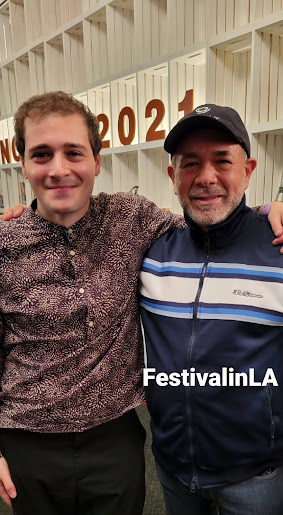
Elie Grappe, “Olga” director at COLCOA, and film critic José Alberto Hermosillo. Festival in LA ©2021

OLGA, French trailer

Related Articles:  

IF YOU ARE READING FROM A MOBILE DEVICE, CLICK: view web version FOR OTHER COOL FEATURES SUCH AS TRANSLATE POWERED BY GOOGLE, AN INTERACTIVE FILM FESTIVAL CALENDAR, AND MORE AWESOME ARTICLES.

 Festival in LA ©2021