Showing posts with label Independent Spirit Awards. Show all posts

Tuesday, February 27, 2024

Anatomy of a Fall: An Intellectual Dissection of a Broken Marriage

 By José Alberto Hermosillo 


"Anatomy of a Fall" is a sublime, thrilling, and transcendental modern work of art - masterfully written, directed, performed, photographed, and edited.


The family courtroom drama focuses on a freak accident, its repercussions, and the unsettled battle of the sexes continuing after death.


The 2023 Palme d'Or winner contains three familiar and robust characters who speak in different languages - French, German, and English- as a common ground. Despite their blood ties, the three members of the family are drawn into life-changing circumstances where death, entrapment, and murder play a significant role in their lives. But absolutely none of them plays the victim in this well-rounded, multi-layered story.
Up in the snowy mountains of Grenoble, France, the apparently harmonious family comprises a successful, busy German author named Sandra Voyter (Sandra Hüller), a frustrated French writer/teacher, Samuel Moleski (Samuel Theis), and their son, Daniel (Milo Machado-Graner).
Milo Machado-Graner is a young and promising actor with a successful career in French movies such as "Stuck Together" and "Waiting for Bojangles." The talented actor is extraordinary in "Anatomy of a Fall." He portrays a legally bling, independent teenager who likes to hike with his service dog, Messi, on the snowy trails of the Dauphine Alps, where they live.
Later in the film, we learn that the intellectual couple constantly fights because they blame each other for their child's accident that left him with impaired vision and how to manage their "precious time" to take care of their eleven-year-old son. 
Because of the accident, Daniel developed a high sensitivity to light exposure, which made him partially blind. He is independent but still needs adult supervision. Despite his impairment, Daniel plays the piano beautifully and walks daily along the mountain trail with his trained dog.
The dog Messi from "Anatomy of a Fall" at the Oscar Luncheon.

Le chien, Messi has been recognized as the absolute winner of the "Palm Dog" Award for his performance in this movie during this past edition of the Cannes Film Festival. He is making big waves on Hollywood's red carpets during the 2024 award season.
After Samuel's tragic death, Daniel continued his piano lesson, rehearsing "Asturias" (Leyenda), which was composed by Issac Albéniz. The strident music played during "The Fall" and replayed during the gathering of evidence is adding to the confusion and chaos. The music recurs and is a pivotal part of the narrative.
"Anatomy of a Fall" is divided into three structural parts: the day of the accident, the trial, and the unexpected resolution.
The film cleverly builds tension in some scenes; in others, it lingers through the beauty of the natural locations thanks to Simon Beaufils's gorgeous cinematography ("My Donkey, My Lover, and I," "Knife + Heart).
After the "fall," the trial is immediate. The film progresses rapidly, as the family has no time to grieve. Furthermore, we see the wife in the house training with her lawyer on what to say or not to say before the trial and how she has to justify the bruises on her arm.
After examining all the evidence and collecting the people's statements, the prosecutors find some discrepancies that may alter the cause of death, whether the case can be considered an accident or murder. Even though the film clearly stipulates the legal repercussions of the "questionable death" that happened a year later.
The prosecutors found the husband's recordings of some of the most recent couple's fights playing in the courtroom. That surprisingly new piece of incriminating evidence may point against the famous writer.
The struggle between the two writers becomes a battle of the sexes, with the husband's evident frustration at his wife's success making him seem to ignite and manipulate those intense discussions. 
The recordings were made without her consent or knowledge, which is considered illegal in some States of the United States. Still, in France, they are used as contentious proof of the couple's instability.

In European films, children are often treated as adults, no matter how complex or disturbing the situations they endure. The legally blind boy becomes the key witness in the case. 
For a child, it is devastating to lose his father, witness his mother's trial, listen to the recordings of his parents' fights in court, and give his crucial testimony that may incriminate or save his mother.
Testifying as an adult makes Daniel aware of the situation, and he must decide whether he would like to save his mother or help the prosecutor bring her to justice.

The performance by German actress Sandra Hüller ("The Zone of Interest," "I'm Your Man," "Toni Erdmann") is impressive. She displays a wide range of emotions, and even when she lies, we think she is telling the truth.
In "Anatomy of a Fall," French director Justine Triet cleverly plays with perceptions of the truth, shaped by each player's needs, interests, and points of view. Justine Trier graduated from the Paris School of Fine Arts and is an Oscar nominee for Best Director; she has an extraordinary filmmaking career with solid previous projects such as "The Age of Panic," "Sibyl," and "Victoria." Across all her films, she has three recurring themes: family, writers, and legal matters.
Justine Triet, Palme d'Or Winner, Cannes. Photo: Par Par François BECKER et © 2023 AFP

In light of the theory of eyewitness unreliability, "Anatomy of a Fall" can be related to Akira Kurosawa's "Rashomon." A few years later, in 1964, Hollywood released a remake of the Japanese classic "The Outrage" starring Paul Newman. This particular Western, directed by Martin Ritt ("Hud," "Hombre," and "Norman Rae"), is another clear example of how the truth can be distorted by witnesses' points of view, backgrounds, beliefs, and personal experiences.
In 1957, Sidney Lumet's "12 Angry Men" rounded off the perceptions of twelve jury members who had to deliver the conviction or acquittal of an eighteen-year-old boy accused of murder. They had reasonable doubts and concluded that there was not enough hard evidence to prove the boy's guilt.
Since its premiere in Cannes, "Anatomy of a Fall" has collected numerous awards worldwide. In the US, the film has been nominated for five Academy Awards, including Best Picture, Best Director, Best Actress, Best Original Screenplay, and Best Editing.
In France, the film won six César Awards, including Best Picture. In England, it won the BAFTA Award for Best Original Screenplay. In Spain, it won Best European Film at the Goya Awards Ceremony, and the list of recognitions for the French/German joint goes on.
In this legal matter, winning or losing the case in court would not bring peace to the souls of the people involved. Still, it raises more questions about what is next when they lose someone they love in a freak accident and if the accident was intentionally planned or a successful suicide attempt. It is all up to the viewer to figure out what really happened.
Regardless of any conspiracy theory, the film is open to public interpretation. Let "Anatomy of a Fall" sit for a while to process an unforgettable film that is making big waves around the world for its enormous quality in storytelling.
Related Articles: 

IF YOU ARE READING FROM A MOBILE DEVICE, CLICK: view web version FOR OTHER COOL FEATURES SUCH AS TRANSLATE POWERED BY GOOGLE, AN INTERACTIVE FILM FESTIVAL CALENDAR, AND MORE AWESOME ARTICLES.

Festival in LA ©2024

Friday, April 14, 2023

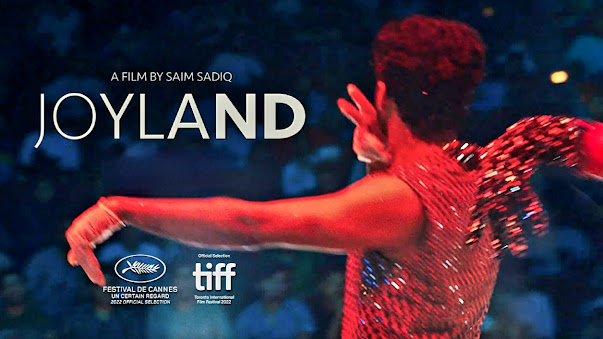
Joyland: A Cinematic Rejoice from Pakistan

By José Alberto Hermosillo


“Joyland” is a poignant allegory of love, despair, and melancholy—an achievement in Pakistani cinema.


“Joyland” challenges consciences on many levels, serving as both a powerful coming-of-age story and a reflection of a society that denies essential rights, such as inclusion, free speech, and equal opportunities for everyone, including those who think outside the box. In life, we often generalize and stereotype others, but instead, we should analyze and evaluate each person as a vital part of the community.


The film focuses on Haider Rana (Ali Junejo) and his conservative family. He lives with his wife, Mumtaz (Rasti Farooq), his father, mother, and his older brother’s family in Lahore, Pakistan.


Haider is an unemployed, hardworking, and shy man who lands a job as a backup dancer in a Bollywood-style burlesque show. Soon, the helpful and naïve man falls for Biba (Alina Khan), a sparkling trans woman who hosts a show at a nearby theater. As circumstances grow more complicated, Haider must navigate his double life carefully.


Biba shares a simple but meaningful joke with Haider: “The chicken and the mosquito shared a kiss. Then, the mosquito died of bird flu... the chicken died of dengue.” She then explains: “Because falling in love means death.” The joke highlights two main, opposing characters: the religious married man and the openly gay transgender person seeking freedom in a conservative society with strict laws.


The vibrant production centers on three distinct and memorable characters: Haider, Mumtaz, and Biba.


For Haider, his family is as crucial as the show’s success. He takes Biba’s safety seriously and cares about his family’s well-being, but balancing everything in real life isn’t easy.


Mumtaz is emotionally fragile. She wants to be pregnant but doubts her husband’s job because of his frequent absences.


Biba’s multidimensional character is neither sugar-coated nor does she pretend to be cute. She is an energetic, confident, and trustworthy trans woman who aspires to emigrate to Germany. Her honesty causes her to reject those who care for her, including Haider. Alina Khan’s performance is as impressive as Daniela Vega’s in the award-winning Chilean film “A Fantastic Woman.”


What is more remarkable about this moving production is that, despite featuring extraordinary actors, it was their first experience acting in films.


 Saim Sadiq, "Joyland." Photo by José Alberto Hermosillo. Copyright © FestivalinLA

First-time writer-director Saim Sadiq describes “Joyland” as a deeply personal project because he comes from a diverse, middle-class family that is also trying to climb the social ladder, much like the characters in his film. Still, he has to recognize that people in Pakistan live in a patriarchal society that imposes limits on progress, love, and desires.


Director Saim Sadiq created an honest and balanced script that consistently emphasizes the “trans” theme and social conflict, building a strong dramatic arc and an open ending. Politically, Saim acknowledges the influence of the extreme right wing in his country and admits that his work will likely upset many. He mentioned that after screening his controversial film in Pakistan, he didn’t expect everyone to stay and applaud. Still, he hoped his film would inspire people to enjoy it, reflect on it, and continue thinking about it.


The highly acclaimed Pakistani film transcends barriers of freedom and acceptance.


It won the Jury Award at Un Certain Regard, Cannes 2022. It also received Best International Film at the Independent Spirit Awards 2023 and Best Artistic Contribution at the Cairo International Film Festival in Egypt. The celebrated movie earned Best Ensemble at the Bangkok Film Festival and the Audience Award at the Valladolid International Film Festival in Spain.


“Joyland” was Pakistan’s submission for Best International Feature Film at the 95th Academy Awards and was one of the fifteen films shortlisted.


The unexpected twists of “Joyland” take us to places we’ve never experienced before. The film’s vibrant urban settings, colors, and textures, combined with compelling storytelling, elevate the cinematic experience and draw viewers into the story.


More importantly, it is crucial to highlight the vibrant Pakistani youth who work hard and aspire to explore new horizons beyond their family’s boundaries, free from social restraints.


In “Joyland,” every character genuinely seeks acceptance, love, and respect, while audiences witness the struggle, beauty, and diversity of Pakistani society and other communities worldwide.

JOYLAND | OFFICIAL TRAILER

Violette: When Women Dare to Write  

IF YOU ARE READING FROM A MOBILE DEVICE, CLICK: View web version FOR OTHER COOL FEATURES SUCH AS TRANSLATE POWERED BY GOOGLE, AN INTERACTIVE FILM FESTIVAL CALENDAR, AND MORE AWESOME ARTICLES.

Festival in LA ©2023

Tuesday, December 31, 2019

Invisible Life: Melodrama is Not Dead In Brazilian Cinema

By José Alberto Hermosillo

“Invisible Life” is a nostalgic, affectionate, and well-crafted masterpiece.

The Brazilian/German co-production is a profound and artistic adaptation of Martha Batalha’s novel “A Vida Invisível de Eurídice Gusmăo,” depicting the lives of two sisters growing up in Brazil and their tortuous separation by their conservative parents in the 1950s - Eurídice (Carol Duarte), the extraordinary pianist/aspiring soloist; Guida (Julia Stocker), yearning to be a devoted housewife.

Invisible Life, still photo ©2019 Amazon Original.

A series of unfortunate events will determine the fate of the Gusmăo sisters. The pre-established authoritarian male structure of that time caused their dear separation.

Life sets them apart, but their hearts remain together through the illusion of writing to each other. Those undelivered letters sustain the melodrama's tightness till the end, like a thread in a very well-structured film.

Furthermore, in the story, the parents force Euricide to marry a man who doesn’t care for her vocation. Eurídice’s strain continues to rehearse and improve herself for the long-awaited audition. 

Guida returns to her parents’ house with her broken dreams and an advanced pregnancy, forcing her to live in the streets.

At that time, women couldn’t aspire for higher education or better-paying jobs in their society, and Sexism suppressed many women’s dreams, goals, and desires.

The sisters’ experience can be compared to our mother's and grandmother's lives, which didn’t have the opportunities they deserved. They could be famous if they were only allowed to fulfill their dreams. 

“Invisible Life” is a well-told family melodrama with social and political substance, transcending to our days in defense of women’s emancipation, if we can read between the lines.

Karim Aïnouz in Los Angeles
Karim Aïnouz, director of "Invisible Life." Photo Jose Alberto Hermosillo ©2019 Festival in LA
 
Director Karim Aïnouz (“Madame Satã,” “Futuro Beach”) made a risky decision to adapt the novel to the big screen with delicacy and mastery.

Born in Fortaleza, Brazil, Aïnouz was inspired in part by the courage and spirit of his single mother’s survival.

After a private screening in Hollywood, Aïnouz was questioned by viewers about altering the novel’s ending. He said adapting the book's conclusion to the screen took over a year. The film's end rightfully complements the entire story, making it more poetic and cinematic. The writer’s team includes Murilo Houser and Inés Botargaray in the credits.

Invisible Life, still photo ©2019 Amazon Original.

In charge of the film's lavish look is cinematographer Hélène Louvart. The talented DP worked in other relevant movies around the globe, such as “Happy as Lazzaro” in Italy, “Maya” in France and India, “Petra” in Spain, “Dark Night” in Florida, “Beach Rats” in New York, and now “Invisible Life” in Brazil.

With many colors and elaborate set compositions, “Invisible Life” is a tropical allegory full of liveliness, heartening emotions, and plenty of nostalgia. It is a story about women with broken wings longing for the lives they could have.

The film’s editing elongates the story's flow and can be confusing if we don’t follow the family tree carefully. Still, the project is enjoyable, regardless of other criticism and respectable points of view.


“Invisible Life” can be compared with other compelling and classic melodramas such as the Best Picture winner “Rebecca” by Alfred Hitchcock, “Imitation of Life” by Douglas Sirk, “Like Water for Chocolate” by Alfonso Arau, and “All About My Mother” by Pedro Almodóvar.

Invisible Life, Italian poster.

“Invisible Life” inspires women to break barriers and close the gender gap in an optimistic sense. 

The Brazilian melodrama won Un Certain Regard at Cannes 2019, the CineCoPro Award at the Munich Film Festival, and was nominated for an Independent Spirit Award.

The timing of this engaging melodrama couldn’t be any better, as we see today’s women pushing back against barriers that limited previous generations from accomplishing their goals and reaching for more opportunities, leaving behind the oppressive world, remarkably and exquisitely depicted in “Invisible Life.”

Film critic José Alberto Hermosillo & director Karim Aïnouz
Jose Alberto Hermosillo, film critic. Karim Aïnouz, director of "Invisible Life." ©2019 Festival in LA


Related Articles: 

IF YOU ARE READING FROM A MOBILE DEVICE, CLICK: view web version FOR OTHER COOL FEATURES SUCH AS TRANSLATE POWERED BY GOOGLE, AN INTERACTIVE FILM FESTIVAL CALENDAR, AND MORE.
 
Festival in LA ©2019

Sunday, December 1, 2019

Les Misérables: Boyz n the French Hood

By José Alberto Hermosillo

COLCOA FILM REVIEW: Brilliant, compelling, and merciless masterwork, “Les Misérables” is a fresh new approach to Victor Hugo’s magnum opus, set in today’s urban, conflicted suburbs of France.

The winner of the Jury Prize at Cannes 2019 endures universal themes of inequality, marginalization, greed, violence, and social injustice.
 
Lodj Ly, director of  Les Misérables at COLCOA. Photo José Alberto Hermosillo, Festival in LA ©2019
 

Director Lodj Ly, influenced by his experiences during the 2005 big-city project riots, adapted Les Misérables from his 2017 Award-Winning short film.


The timing of this astonishing film debut couldn’t be better. Lodj’s story begins with the eruption of collective euphoria on the streets of Paris, sparked by the victorious celebration of France’s 2018 FIFA World Cup win in Russia. The event unified the country and also highlighted its social differences.


The film moves from the iconic Parisian monuments to the not-so-charming projects of Montfermeil, 10 miles east of Paris. Inside those tiny apartments in the middle of the raucous construction site, people crowd in, surviving on limited resources and in difficult circumstances.

 
As the camera moves in, conspicuously, we start to learn more about the composition of the new French society, integrated by Africans, Muslims, and Middle Eastern immigrants. Their descendants: hundreds of young people out on the streets, as a chorus in this never-ending operatic composition, trying to tell us something more meaningful and substantial about people’s struggles.

From the very beginning, the antagonistic groups line up. Among them are the gypsies, owners of a colorful circus; the black immigrants; the mafia guys; the Muslim Brotherhood; and the shady cops.


The officers’ actions trigger out-of-control chaos, and the anarchy could jeopardize their well-being. The compromising situation can be overwhelmingly dangerous and explosive, like a Molotov cocktail.


In her more serious role as Le Commissaire, Jeanne Balibar (known for “Barbara” and “I Hate Love”) instructs her police officers about the concept of “solidarity” at the police station: “There is no solidarity without a team; we are alone; you only have each other.” She introduces a new member, Brigadier Stéphane Ruiz, played by Damien Bonnard (from “The Trouble with You” and “Dunkirk”), to the squad. The other two officers, Chris and Gwada (portrayed by Alexis Manetti and Djibril Zonga), are hesitant to accept the rookie.


During the patrol, Chris takes the lead, acting above the law and feeling like the new sheriff in a cowboy-movie town. He thinks he can do whatever he wants.


The officers’ felonies begin with harassment of teenage girls at a bus stop. They must also deal with merchants and informants at the open market or mediate between gypsies and Muslims over a stolen lion cub.

 
As the story unfolds rapidly, only some trends become fully resolved. The audience wants to follow up on a video taken by a drone operated by a kid who witnessed police brutality. We want to know whether the video went viral and what viewers’ reactions are in the story - after all, things get out of control effervescently. 

Lodj Ly, director of  Les Misérables, and actors Damien Bonnard and Djibril Zonga at COLCOA. Photo José Alberto Hermosillo, Festival in LA ©2019

This new, more visceral adaptation of Les Misérables was inspired by director Lodj Ly’s witnessing of police brutality. 


He said his film was hard to finance because of its subject matter. It took him nearly ten years to make. Two hundred people participated in his epic production. The young actors were primarily children from the immigrant community with no experience, hope, or future. By participating in this film, they found new meaning in their lives. 


In Lodj Ly’s words, he compromises with the marginalized, underprivileged immigrant community. Therefore, he is creating a film school to introduce children to the visual arts and to let them tell their stories through powerful images of their surroundings. 

 
Lodj Ly, director of  Les Misérables at COLCOA. Photo José Alberto Hermosillo, Festival in LA ©2019

French society unifies when the World Cup is won. Soccer gives a feeling of belonging to a country. But when the game is over, everyone goes back to their differences. 


The reality presented in Les Misérables shakes the viewer by juxtaposing collective happiness with the anarchy caused by corrupt cops. The award-winning project vividly depicts young people struggling with a lack of future in an alienating society.


The French film is cathartic, offering a small window of hope and the possibility of constructing an inclusive society soon, in an idealistic sense. 


 Djibril Zonga, actor. Photo: José Alberto Hermosillo, Festival in LA ©2019
Lodj Ly, director of  Les Misérables. Film critic José Alberto Hermosillo, Festival in LA, ©2019 
 
 
Related Articles:
Festival in LA ©2019