Showing posts with label France. Show all posts

Sunday, November 5, 2023

Anselm: The Most Transcendental Artist of Our Time in 3D

  By José Alberto Hermosillo 


“Anselm” is a luminous and poetic documentary about the monumental work of the German iconoclast Anselm Kiefer.


Directed by award-winning filmmaker Wim Wenders (“Wings of Desire,” “Faraway, So Close,” “Paris, Texas,” “Pina 3D,” “The Salt of Earth,” and most recently “Perfect Days” in Japan), the documentary, titled in German “Anselm – Das Rauschen der Zeit,” offers a deep understanding of Kiefer’s oeuvre, focusing not on his personal life but on his body of work. The documentary adds 3D and 6K resolution, lending Kiefer’s art an immersive, fascinating luster. 


As the story unfolds, watching him work passionately and intensely in his considerable studio in the Renaissance town of Barjac, in southern France, is a delight for all the senses.


The German artist is one of the most important exponents of Neo-expressionism. Many consider him a humanist for reflecting an essential part of the human condition in his work. The nonconventional visionary artist works with all the elements he can find in his surroundings. 


He likes to expand beyond the frame to create his vast masterpieces. The mixed media on canvas he uses is only a tiny part of his architectural interiors and immense landscapes.


For one of his series, he burns an enormous amount of dry grass on a wall. He adds paint, plaster, concrete, and molded metal – giving the canvas a unique structure, shape, color, texture, depth, and smell. 


Anselm Kiefer’s artwork transmits a sense of universality and infinite freedom to the spectator.


Anselm Kiefer was born in the Black Forest, in the southern town of Donaueschingen, Germany, in 1945, just at the end of WWII. His influences are the Norse legend, Wagnerian Opera, and Germany’s Nationalistic identity, including the Nazi shameful period he brought to the center of the conversation.
 
The extraordinary footage of the film includes still photographs from when he was thirty, making him seem different back then. Anselm Kiefer was a provocateur doing a photography series traveling around the world dressed in his father’s Wehrmacht uniform (German Armed Forces), displaying the Nazi salute during the 1968-1969 period.
 
He started as a bold artist who worked on the borderline between conventional and controversial presentations of his creations, ideologically speaking.
 
In contrast, he vividly paints the other side of history evenly by exposing the gas chambers of the concentration camps during the Holocaust. Other essential works also address the Jewish community’s exodus to Israel, as reflected in the exhibits. From one particular point of view, he cannot deny the obscure past of his heritage. Nevertheless, we can find healing and reconciliation through his magnificent art.

In some of his pieces, he compares mushrooms with cancer cells, and we can see how those fungi expand rapidly in the woods, as cancer does in the human body.


The indelible reality of Kiefer’s work comes in the series titled “Memory,” which I find reflects similar sentiments in the creation of Mexican painter Frida Kahlo. Still, at a large scale, where what people see is not exactly what the piece represents, it is essential to know Kiefer’s work because it is transcendent for the ages.
 
Some people accused him of being fascist, but Mr. Kiefer cannot control people’s reactions to his creations. He can not be standing in front of every piece telling viewers, “I am antifascist,” to defend himself. Nowadays, it is still not clear what he was before, but certainly, he is not a Neo-Nazi.

Anselm Kiefer has exhibited those gigantic pieces in Venice, Bilbao, Hamburg, Tel Aviv, Chicago, New York, San Francisco, and Los Angeles, to mention a few cities where his work has been acclaimed.

The nonintrusive cinematography was done by Wenders’ frequent D.P. collaborator Franz Lustig (“Aftermath,” “Perfect Days,” “Don’t Come Knocking”). 

The arresting visuals surrounding Kiefer’s work create a mystical atmosphere, prompting spectators to continue wondering about his creations and his personal life in a more intimate setting. Still, that story is yet to come, likely in a French or Hollywood biopic. For now, we must be content with this astonishing documentary.
 
The purpose of art and cinema, in particular, is to open up the discussion about the life and work of a controversial artist and to make audiences aware of the existence of such an essential and celebrated talent as Anselm Kiefer.

Related Articles:
IF YOU ARE READING FROM A MOBILE DEVICE, CLICK: view web version FOR OTHER COOL FEATURES SUCH AS TRANSLATE POWERED BY GOOGLE, AN INTERACTIVE FILM FESTIVAL CALENDAR, AND MORE AWESOME ARTICLES.
Festival in LA ©2023

Tuesday, September 12, 2023

Passages: A Very Sui Generis Love Affair in Paris

By José Alberto Hermosillo


In the era of diversity and inclusion, “Passages” is a successful attempt by Queer Cinema to crossover into mainstream media. 

“Passages” is a refreshing and sophisticated new French/German Queer drama attempting to explore the laws of attraction, arousal, behavior, and human sexuality without bounds in this modern love story.

The eternal triangle scenario centers naturally on a same-sex couple struggling over an infidelity one of them had with a woman. The problem is that the suitor likes exploring his bisexuality further with the opposite sex and wants to keep it that way, but his heart is attached to his husband.


Triggered by his husband’s rejection, self-centered German director Tomas Freiburg (Franz Rogowski) falls into an extramarital steamy relationship with Agathe (Adèle Exarchopoulos), an elementary school teacher, who falls for him carelessly. 


In a short period, Tomas’s intellectual husband, Martin (Ben Whishaw), witnesses how Tomas is going into self-destruction mode and how his erratic conduct affects other people’s lives, including their fifteen-year marriage.


Franz Rogowski as Tomas is extraordinary. He plays the perfect antihero of the story as an openly gay film director with enormous emotional baggage.


Rogowski’s charming and even cynical smile and profound gaze convey the right emotions to captivate his audience, elements that make the actor continue to grow, as evident in his previous performances in “Transit,” “Undine,” “Great Freedom,” and the upcoming “Disco Boy.” With enormous confidence, he conquers the screen as one of the greatest European actors of our time.


His counterpart, British actor Ben Whishaw, is terrific as the dedicated and betrayed husband. His character, Martin, is a low-key graphic artist and owner of a high-end print shop. In the film, his break-up does not prevent him from fooling around with other guys in their social circle. 


Whishaw is a chameleonic actor who has performed excellently for almost three decades. His most iconic roles were in the 2006 “Perfume: The Story of a Murder,” alongside Dustin Hoffman, and in the British period film “Bright Star.” More recently, he worked in “Paddington,” “Skyfall,” “No Time to Die,” and the Award-winning feminist piece “Women Talking” as the raconteur of the women’s struggle.
 
The questionable concubine Agathe is exquisite, confident, and feminine with traditional French parents. She is a practical woman who does not give importance to her new partner’s lifestyle. Agathe is played by the always sumptuous Adèle Exarchopoulos (“Blue is the Warmest Color,” “Les anarchistes,” and “The White Crow”).


Film director Ira Sachs (“Frankie,” “Love is Strange”) ’s fierce and meticulous method of directing actors demonstrates her ability to get the most out of them professionally. In her work, she introduced a new kind of “Teorema,” referring to the type of sexuality presented in the 1968 Pier Paolo Pasolini’s Italian Cult Classic “Theorem.” 


“Passages” has intricate relationships and a playful tone similar to Bernardo Bertolucci’s “Dreamers.” The modernity of Nadav Lapid’s storytelling in “Synonyms” elevates Sachs’s work to a new and profound level of understanding human behavior.
The luxurious cinematography enhances the sharp colors, and close-up imagery focuses on the subjects, a responsibility of talented Josée Deshaies (“Lamb,” “Saint Laurent,” “Curling”). It has an effervescent atmosphere and creates an uneasy feeling of wonder and anxiety in the spectator.


A big shout-out to the costume department for showing French fashion on a large scale. Every character is dressed in a way that reflects their personality, leaving no doubt about who is who in the story.
 
The set design department did a fabulous job choosing those unknown locations in Paris. The interior design, furniture, and accessories are superbly colored. On the couple’s living room wall hangs the iconic poster for the 2019 Emmy-nominated LGBTQ documentary The Circus of Books by Rachel Mason. It is festive and refers to Tomas’ passion for fine print and the couple’s happiness when they were together.


“Passages” is a freshly made, entirely original film full of surprises, making it impossible to know where every scene will take you next.


Besides how strident and sexually explicit y the film can be, there is a time for reflection on the direction our society is taking. In times of solitude, moving on from a long-term relationship is complicated, especially when the people they trust and love are not supportive. Therefore, it is worth our time to watch one of the year’s best films, which features strong production values, impeccable direction, and terrific performances that convey emotion to the audience. 


IF YOU ARE READING FROM A MOBILE DEVICE, CLICK: view web version FOR OTHER COOL FEATURES SUCH AS TRANSLATE POWERED BY GOOGLE, AN INTERACTIVE FILM FESTIVAL CALENDAR, AND MORE AWESOME ARTICLES.

Festival in LA ©2023

Wednesday, January 18, 2023

Fire of Love: The Everlasting Stars of Volcanology

 By José Alberto Hermosillo

Dangerously real and transcendental. “Fire of Love” ignites the lover’s passion for Earth Studies 101 enormously. 

“Fire of Love” is a complete recompilation of materials related to volcano studies collected deep from the archives of Katia & Maurice Krafft. The French couple discovered their magnetism for each other and volcanoes. Attracted by the powerful energy emanating from the Earth’s interior, they defied nature to fulfill their hunger for knowledge. This Academy Award-nominated documentary can help save lives in communities around volcanoes worldwide.

The daredevils of volcanoes are here to enlighten humanity through their amusing discoveries and heart-pounding missions, leaving an everlasting legacy.

This eye-opening documentary summarizes hundreds of hours of invaluable footage, original materials, incredible photos, specific samples collected from locations, and millions of questions.

Before 1966, all we knew about volcanoes was generic. Geology classified volcanoes by region, age, and size—until the Kraffts came with their exhaustive research, studying every volcano individually.


Since they met in a Paris coffee shop, the French couple could not live apart and embarked on a series of overseas expeditions to study each volcano individually. When they were children, their parents took them separately to visit the volcanoes in Italy – they started with the Stromboli.

In 1970, they married. Their honeymoon was in Santorini, the mythical city of Atlantis. They devoted their lives to studying volcanoes and decided not to have children. The newlyweds were the first and probably the only volcanologist couple in the world, and they revolutionized every previous theory about volcanoes and tectonic plates. 

Once they start their journey, the film’s visuals and environmental sounds blend together, complemented by “Je Me Sens Vivre,” a romantic French song by Dalida.

Dalida -- Je Me Sens Vivre

They brought down every theory and myth about volcanoes, even the truths and fragments of history already set in books. As they went deeper, more questions arose. They traveled to different countries, continents, and Islands, starting with Mt. Edna and Stromboli in Italy to begin their investigation. They knew that every mystery had to be solved. They lived every new adventure to the fullest.

TV appearances were recorded during their studies, and it was an excellent opportunity to show the world that studying volcanoes must be done individually, not as a generic classification. Every volcano is a different animal. And they were more excited to show their findings when the TV became color.


They had their strengths—Katia worked on still pictures, printing books, chemistry, soil composition, gases, and physics. Maurice filmed everything on location, including eruptions, and kept the records and archives in order. 

Both complemented each other exceptionally well. The closer they got to the volcanoes, the more they saw, and the more they became volcano runners. Even local people helped them with supplies and guidance to reach the craters.

Contemplating the devastating landscape surrounding a volcano, Maurice and Katia stated, “We are not religious; we are scientists, but we have our short life to return to the ground.” They romanticized their job, driven by their passion for volcanoes and each other. Katia observed 170 volcanoes, Maurice 150, 20 fewer than hers.

Maurice prefers an intense and short life to a monotonous, long one. In his existentialist philosophy, he feels his life is a kamikaze mission in the beauty of volcanic things and the strenuous sounds of volcanic explosions. 

They developed a new classification theory for volcanoes: Red and Grey. They named Red Volcanoes after the red magma moving beneath the plates, and Grey Volcanoes after the grey smoke and ash. Red volcanoes produce the most fertile soil for plant and vegetable growth. But these were the more explosive, the monster volcanoes, the killer volcanoes, such as Mount St. Helens in the US near Vancouver, Canada.


“Volcanology is a science of observation. The closer they get, the more they see.” With the new gear, they could get closer to the edge. In their fascination with danger, the unknown is not to be feared, but something is not torn. When Krakatoa erupted in Indonesia in 1971, scientists studied the chemistry and water composition, including the acidity that killed all organisms surrounding the volcano. In 1973, they visited one of the world’s most active volcanoes. Mt. Nyiragongo in Zaire, now the Democratic Republic of Congo, will continue the studies of lava and soil composition.

The signs before a blast are the alteration of minerals, gases, soil temperature, and tremors that ignite an eruption, but there is no certainty to know when or at what time. “Going to the site of a volcanic eruption is like playing Russian roulette - you never know when you will be killed,” said Maurice.  


In 1985, the volcano Nevado del Ruíz erupted in Colombia, killing around 25,000 people while they slept. The government ignored evacuation warnings, and Katia arrived to testify about the damage. Since then, the Kraffts’ film has been used as educational material to warn communities near volcanoes to evacuate and save lives because timing is everything.

Independent writer, producer & director Miranda July narrates “Fire of Love.” FestivalinLA ©2011

Independent filmmaker Miranda July’s narration in “Kajillionaire,” “Me You and Everyone We Know,” and “The Future” is vivid and evocative. 


Sara Dosa, Fire of Love
Sara Dosa, director of “Fire of Love.” Photo by José Alberto Hermosillo. FestivalinLA ©2023

The documentary, co-written and directed by Sara Dosa (producer of the Academy-nominated “The Edge of Democracy”), powerfully portrays the well-selected material. Dosa did a marvelous job assembling this gigantic puzzle from Krafft’s materials, studies, and discoveries.


Legendary German filmmaker Werner Herzog worked on a few projects focused on the Kraffts - “The Fire Within” and “Into the Inferno.” Still, nothing compares to the force of “Fire of Love” through its imagery and consistent structure.


The selected material can be compared to the fabric of other Academy Award-winning music documentaries, such as “Summer of Soul” and “Amy,” about the life of Amy Winehouse, where home videos are a key element in helping the world connect with the legendary singer.


What keeps us watching the documentary is the fantastic material and the lives of those two passionate French investigators who pursue their dreams and dare, like no one else, to go further. Katia, Maurice, and the Volcanos’ love story. 

Fire of Love Trailer | National Geographic

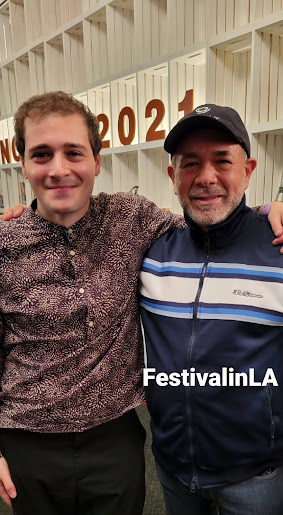
Sara Dosa, director of “Fire of Love.” Film critic José Alberto Hermosillo. FestivalinLA ©2023

Related Articles:
Laura Pausini: Pleased to Meet You, Recounts the Life of the Italian Megastar

IF YOU ARE READING FROM A MOBILE DEVICE, CLICK: view web version FOR OTHER COOL FEATURES SUCH AS TRANSLATE POWERED BY GOOGLE, AN INTERACTIVE FILM FESTIVAL CALENDAR, AND MORE AWESOME ARTICLES.

Festival in LA ©2023
Thursday, November 18, 2021

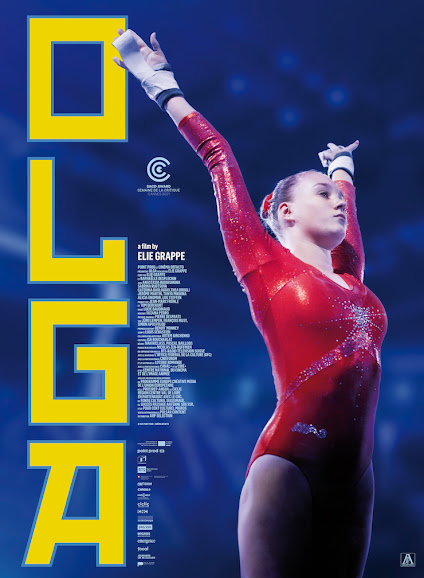
Olga: The Ukrainian Gymnast Who Represented Switzerland at the European Championships

By José Alberto Hermosillo

COLCOA REVIEW: “Olga” is a realistic and captivating dramatization of a Ukrainian gymnast who struggles to achieve her dreams in and outside her country.

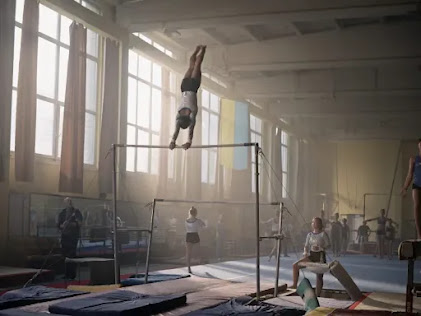
The Swiss/French co-production is a fascinating and honest portrait of the world of gymnastics and what athletes must do to participate in international competitions. Young female athletes undergo intense “military” training conjoined with a tumultuous external political environment, which affects their mental health and well-being. 


Gymnast-turned-actress Anastasia Budiashkina is a true revelation. 

Olga, a 15-year-old Ukrainian gymnast who was exiled to Switzerland, works tirelessly to secure a place at the country’s National Sports Center and compete at the European championships.

The story progresses from her specific physical training to the external political conflict afflicting her homeland, which touches Olga’s psychological stability.

Her mom is a notorious journalist who worked to uncover corruption cases and to expose President Yanukovych’s refusal to sign the free trade agreement with the European Union. During Ukraine’s Euromaidan of 2013, Olga’s mother became a victim of political persecution, repression, and brutality.

Witnessing the riots in Switzerland, Olga suffers anxiety and excessive psychological damage that affects her performance. Far from her Ukrainian teammates, she can still connect with them through a smartphone, where she catches a glimpse of what is happening with her mom.

The film simultaneously depicts the girl’s experience of the political crisis in her native land, her adolescent crisis, and the immigrant challenges in her social world.

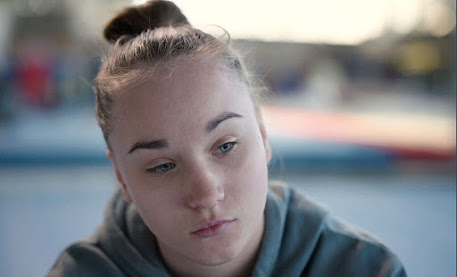
Actress Anastasia Budiashkina delivers Olga’s astonishing, raw, and faithful incarnation. Her strong body denotes solid gymnastic skills, conveyed by her expressive blue eyes, which flawlessly exhibit her character’s vulnerability.

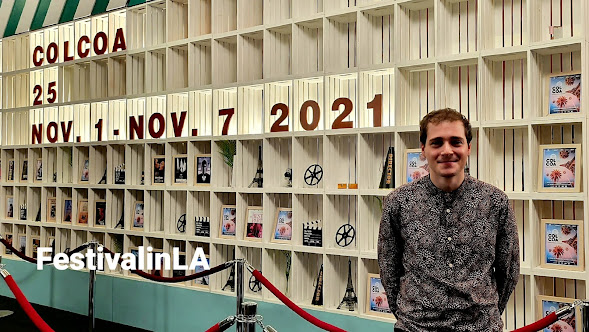
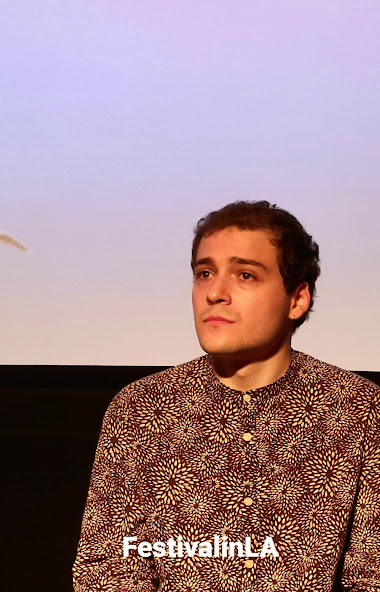
Elie Grappe, “Olga” director at COLCOA. Photo: José Alberto Hermosillo. Festival in LA ©2021

First-time French director Elie Grappe pulls off a compelling work. Fortunately for the director, project, and viewers, she is both a professional actor and athlete accustomed to competing in large-scale arenas.

In a related real-life story, the turmoil that affected the US gymnastics team at the Tokyo 2020 Olympic Games was psychological pressure, mental stress, and other external factors that physically undermined the athletes’ performances. As news of the American team’s challenges spread worldwide, the timing of “Olga’s” release could not be better, serving as an inspirational beacon for thousands of young athletes who dream of competing in the Olympics and can relate to Olga’s experience.

Elie Grappe gave the young actresses enough space to display their emotions, as he wanted to show their passion, desires, and true nature right from the beginning. The story focuses on a young girl with a strong body and an athletic complexion, ready for an international championship.

Elie Grappe tells the story authentically through functional, spacious settings, clearly intended to lend his first feature film a “documentary look” while creating dramatic moments in intimate settings.

Elie Grappe, “Olga” director at COLCOA. 
Photo by José Alberto Hermosillo. Festival in LA ©2021

The director made the good work an essential part of the film to heighten the intensity of every scene, focusing on the athlete’s stress, training, failures, and accomplishments. He wanted to convey the main character’s anger and confrontation with the rest of the world through sound, acoustics, and vital musical tones. He thus bolsters the whole atmosphere by recording the participants’ training with dynamic microphones.

French director Elie Grappe emigrated to Switzerland at 17, and it took him 10 years to make “Olga.” 

The COVID-19 crisis, too, severely impacted the crew during the lockdown. When one of the members died, filming was suspended. After a year, they faced another challenge and returned to complete the movie. Evidently, the young actors had grown relatively quickly and no longer looked the same as before the pandemic.  

The editing slows down the action, and Olga’s failures are repetitive, leaving the audience wondering if she will succeed.

Selected as the Swiss entry for the Best International Feature Award at the 94th Academy Awards, “Olga” is the winner of the SACD Award at the Critics’ Week in Cannes 2021. It also won Best Picture at the Brussels International Film Festival and Best Feature at the Hamburg International Film Festival.

“Olga” is about the struggles and choices a gymnast has to make to become somebody, whether she wants to be a Swiss champion or a Ukrainian patriot. 

Elie Grappe, “Olga” director at COLCOA, and film critic José Alberto Hermosillo. Festival in LA ©2021

OLGA, French trailer

Related Articles:  

IF YOU ARE READING FROM A MOBILE DEVICE, CLICK: view web version FOR OTHER COOL FEATURES SUCH AS TRANSLATE POWERED BY GOOGLE, AN INTERACTIVE FILM FESTIVAL CALENDAR, AND MORE AWESOME ARTICLES.

 Festival in LA ©2021