Friday, July 26, 2019

Honeyland: The Last Beekeeper of North Macedonia

By José Alberto Hermosillo

“Honeyland” is one of the year's most outstanding achievements in filmmaking. This realistic and dramatic documentary portrays the living conditions of a beekeeper in a rural area of North Macedonia, conditions that no one can ignore. Remarkable, environmentally opportune, and unmissable.


“Honeyland” chronicles the life of a determined provincial woman who stoically defies both other humans and nature to save the world.


In the mountains of North Macedonia, we follow Hatidze’s journey, a forgotten native and bearer of an ancient secret about bees - where they are located and how to take care of them. 


As she collects half of the honey, she shares the other half with the bees. She knows the ancestral s: that the bees also need nectar to survive through the seasons.


Honeyland photo courtesy of Neon

Hatidze also takes care of her 85-year-old mother. Their connection is symbiotic, and their codependency is profound. They are emotionally supportive of each other.

In their humble hut, the mother hopes for her middle-aged daughter to marry a suitable prospect. Something more than impossible for being the only two living souls up in the mountains of the Balkans peninsula.  

We see her happily walking miles to the city market, where she interacts with other vendors, mostly Albanians and Bosnians, who tell her how much she can sell her honey for. In exchange, she can buy goods such as bananas for her beloved mother.

Honeyland photo courtesy of Neon

When she returned, new neighbors arrived. A family of Turkish nomads in their mobile home, with cattle and eight children. All survivors are hungry and ready to take over. That also includes the bee business and merchandising the honey for a higher price.

Honeyland photo courtesy of Neon

“Honeyland” is enthralling and exciting. The humor centers on the free-spirited children pushing their luck as they interact with the animals.


A few weeks pass before greed alters the natural balance. Without any environmental action, biblical repercussions unfold in this tiny part of the wealthiest continent, Europe. 


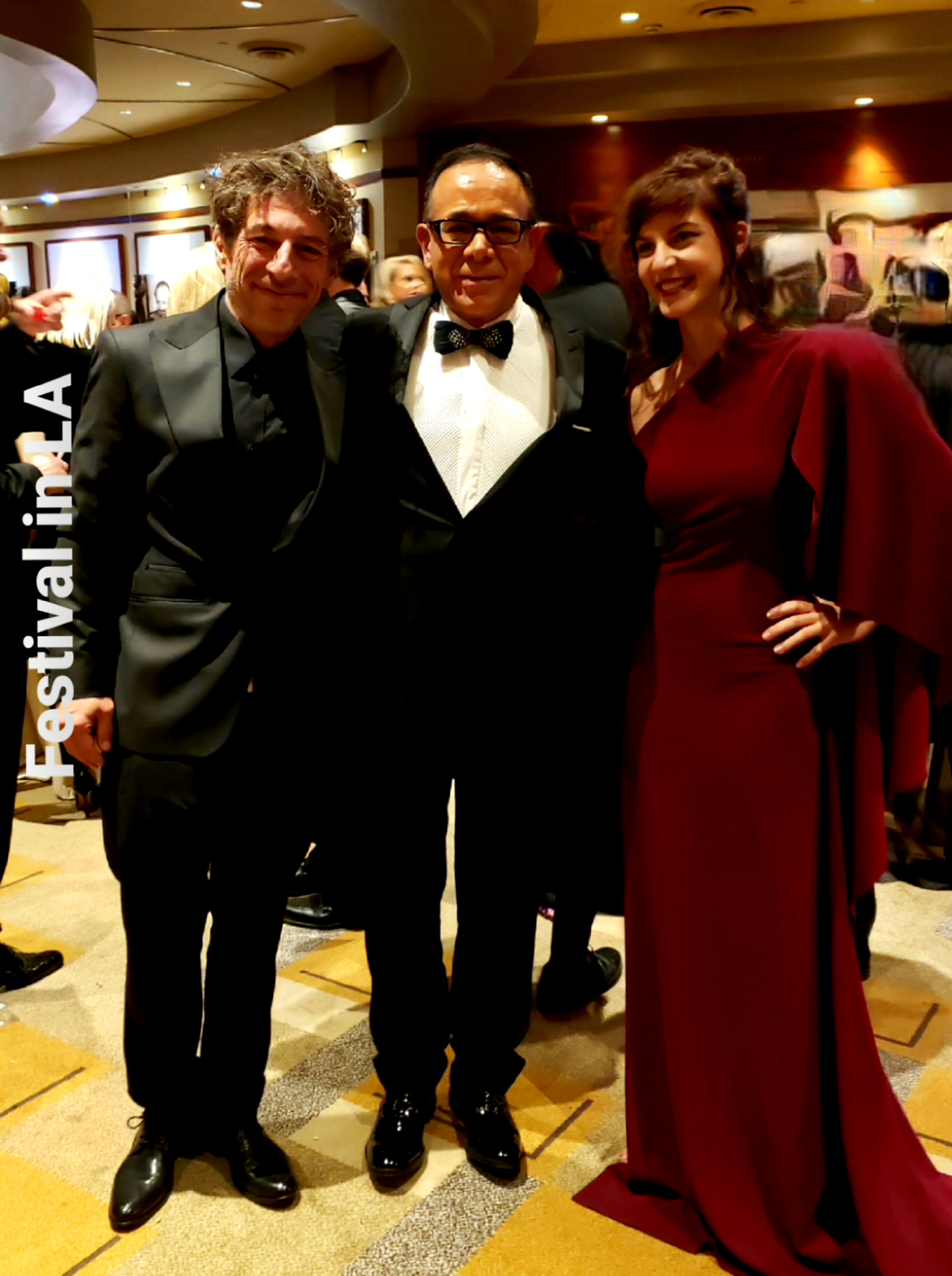
Ljubomir Stefanov and Tamara Kotevska, filmmakers of Honeyland.
Photo José A. Hermosillo, Festival in LA
©2019

The talented filmmakers Ljubomir Stefanov and Tamara Kotevska worked for three years, shooting this endearing documentary in a rural location where filming conditions were challenging.


Their small crew had no shelter or showers; they camped in tents. For that reason, they shot only four to five consecutive days a week, then returned to civilization to recharge batteries. 


They took one full year to edit more than 400 hours of footage and to follow three storylines harmoniously: the beekeeper, the restless family, and the land. 


Honeyland photo courtesy of Neon

The editing runs flawlessly and is entertaining. The linear structure is so good that it is hard to tell whether we are watching a documentary or a narrative. 

In making this film, the children helped convince the adults to participate in the documentary. Initially, it was difficult for the filmmakers to approach the family, who were a fundamental part of the story.

Their eco-friendly documentary delivers a compelling message – if we use all the natural resources at once, we will have nothing left to continue living. We must conserve some supplies for the future, and users and providers must keep a balance on Earth, or everything will be lost.

Ljubomir Stefanov and Tamara Kotevska, filmmakers of HoneyLand.
Photo José A. Hermosillo Festival in LA
©2019

The American environmentalist documentary “The Biggest Little Farm” has a much more sophisticated approach to how climate change affects how we produce and consume natural products.

Also, the Swedish documentary “More than Honey” states: “If the bees disappear, humans will follow within three years.” The epic European production takes a global approach and an ambitious solution. At the same time, the North Macedonian work focuses on a microcosm, their land, and how the last remaining beekeeper fights for the bees’ preservation.

Ljubomir Stefanov and Tamara Kotevska, filmmakers of Honeyland.
Photo José Alberto Hermosillo Festival in LA
©2019

Coincidentally, the documentary juxtaposes parallel universes: Hatidze and her mother in their hut mirror the bees in their hive. The mother is the queen who never leaves the house, and the bees are organized hierarchically.


For Hatidze, dyeing her hair symbolizes beauty, an aspiration to be beautiful even in the hills, without realizing that the bloom lies within her noble heart. 


According to the filmmakers, “This story has no villains, only victims of consumerism. The inhabitants must be more persistent and immune to the capitalist system that devours everything.”


For many, including me, “Honeyland” is a masterpiece; it has won more than 11 awards at festivals worldwide, including this year’s Grand Jury Prize and Best Cinematography at the World Cinema Docs in Sundance. The film also won the Special Jury Prize for Impact & Change at Sundance. It won Best Documentary at the Montclair Film Festival and Best at Docs Barcelona, Spain. 


I hope to have the filmmakers back in Los Angeles for the Award Season because “Honeyland” is a documentary worthy of Oscar and Spirit Award nominations.


Hatidze in Honeyland photo courtesy of Neon

Hatidze, the beekeeper, realized her dream when she could tell her unbelievable story so generously in the film, creating an environmental conscience and vividly conveying her love for the bees, making the audience part of her fascinating universe named “Honeyland.”

Ljubomir Stefanov and Tamara Kotevska, filmmakers of Honeyland. 
Film critic José Alberto Hermosillo. Photo: Gabriel Romero, Festival in LA ©2019


Ljubomir Stefanov and Tamara Kotevska, filmmakers of Honeyland. 
Film critic José Alberto Hermosillo, at the Academy Awards Festival in LA, ©2020


TO ACCESS OUR INTERACTIVE FILM FESTIVAL CALENDAR FROM YOUR MOBILE PHONE, CLICK AT THE END: View web version. 
Festival in LA ©2019

Monday, July 8, 2019

The Art of Self-Defense: Can Karate Cure Loneliness in a Hyper-masculine World?

By José Alberto Hermosillo

“The Art of Self-Defense” is a hilarious and quirky dark comedy you don’t want to miss. It’s one of the best independent films of the year! The remarkable cast includes Jesse Eisenberg, Alessandro Nivola, and Imogen Poots, all of whom deliver extraordinary performances. 

Not long ago, Meryl Streep claimed there is no art in football and mixed martial arts. Many people worldwide disagree - not even Casey (Jessie Eisenberg), who starts taking karate lessons after a random violent attack.

The Art of Self-Defense Photo courtesy of Bleecker Street Media

By immersing himself in this shadowy world of martial arts, Casey will aim to build self-confidence, strength, and a more masculine personality.

At the dojo, he is greeted by Anna (Imogen Poots). She is a confident, young, yet somewhat isolated karate instructor. As a woman, she is herded into teaching kids in the mornings instead of competing in evening matches against men. Those fights could bring her closer to achieving her well-deserved black belt.

The Art of Self-Defense Photo courtesy of Bleecker Street Media

The grandmaster is Sensei (Alessandro Nivola). His strange and magnetic personality makes him appear lifelike. He wants to be in control. His captivating charm draws Casey into his business, which offers mind-and-body training.


When actor Alessandro Nivola read Riley Sterns’ great script, he thought it was original, intricate, and somehow controversial. Those are the key ingredients for an independent film to succeed. In the screenplay, he saw the importance of emphasizing the dialogue with personal tones.


The Art of Self-Defense Photo courtesy of Bleecker Street Media

Nivola was worried about learning karate in four days instead of focusing on incorporating complicated long sentences into his part. During the shoot, Nivola took a deep breath, knew his lines, and delivered them as well as he could. Nivola is terrific playing a low-key psycho.

“Kick with your fist, punch with your feet.”
“Karate is a way of communicating.”
“Never hold back; it makes you weak.”

Sensei is a master at manipulation. He crafts a sinister plan to maintain his reputation and succeed in his martial arts school business.

Alessandro Nivola. Photo: José Alberto Hermosillo

Alessandro Nivola accents his character to make it more realistic. Sensei enjoys playing God with subtle cruelty, controlling his kingdom and minions, much like Ed Harris in “The Truman Show” (1998). A performance that earned Harris an Oscar nomination for Best Supporting Actor that year.

The Art of Self-Defense - Arclight display. Foto: José Alberto Hermosillo. Festival in LA ©2019

In “The Art of Self-Defense,” director Riley Stearns explores “male loneliness” with depth and elevates his actors’ performances. Christian Bale in “The Machinist” delivers a similar interpretation to Jack Plotnick in the film called “Wrong” by Quentin Dupieux.

The Art of Self-Defense - Arclight display. Foto: José Alberto Hermosillo. Festival in LA ©2019

Jesse Eisenberg’s portrayal of the lonely character is perceptive. His impotence and frustrations come across in every action. His passive-aggressive personality intensifies until he becomes the person he aims to be.


In “The Art of Self-Defense,” Jesse Eisenberg isn’t a “Rocky,” but he can put on a good show.


The main point of this movie is to see how the behavior of a powerful, dominant character influences everyone, and how the rest of the group might eventually fight back.


In a tough world, we have to make the best of it. After watching “The Art of Self-Defense,” you might think twice about signing up for some great karate lessons to protect yourself. 


Alessandro Nivola, actor. Film critic José Alberto  Hermosillo. Festival in LA ©2019


TO ACCESS OUR INTERACTIVE FILM FESTIVAL CALENDAR FROM YOUR MOBILE DEVICE, CLICK: View web version.
 
Festival in LA ©2019

Friday, June 28, 2019

VIVE MEZCAL: OAXACA INVITES YOU TO A MEZCAL SUMMIT

By José Alberto Hermosillo
Vive Mezcal, Oaxaca 2019 Yola 1971. Proud exhibitor www.festivalinLA.com

Oaxaca celebrated “Vive Mezcal” in September 2019. The organizers from the State of Oaxaca promoted their city’s largest Mezcal Summit in Los Angeles.


Oaxaca’s paradisiacal beaches became famous in 2001 with the Oscar-nominated film “Y tu mamá también” by Alfonso Cuarón. In the story, a trio played by Diego Luna, Gael García Bernal, and Maribel Verdú drank mezcal, ate the worm that comes inside the bottle, and had sex afterward.


As shown in the film, Oaxaca is known for its friendly people, ancient culture, exquisite cuisine, and famous mezcal.


Oaxaca Authorities Promoting in Los Angeles: Vive Mezcal. Photo José A. Hermosillo

According to representatives of the Southern State, Oaxaca’s best feature is its cuisine, which includes the traditional spirit mezcal. Just as tequila is iconic for Jalisco, mezcal is for Oaxaca. The name of the distilled alcoholic drink, “mezcal,” comes from the Nahuatl (Aztec language) and means “oven-cooked agave.”

Secretary of Tourism Juan Carlos Rivera Castellanos, promoting Vive Mezcal. Photo: José A. Hermosillo

The Secretaries of Economy, Juan Pablo Guzmán, and Tourism, Juan Carlos Rivera, organized this promotional business meeting in Los Angeles to encourage people to visit their beautiful country for an unforgettable experience.
 
The event brought together investors, restaurant owners, importers, and local press representatives.

Quesadilla at La Guelaguetza Restaurant. Photo: José A. Hermosillo

The guests savored a variety of delicious mezcal and the exquisite cuisine of the iconic Guelaguetza Restaurant.


The L.A. eatery gained fame for being featured in the 2015 documentary “City of Gold.” The film chronicles the experiences of food critic, culinary geographer, and Pulitzer Prize winner Jonathan Gold, who frequently visited the restaurant during his lifetime.


Tostadas de chileajo, Guelaguetza Restaurant. Photo Jose A. Hermosillo

This restaurant, located near Downtown Los Angeles, was the perfect place to enjoy delicious food and exceptional mezcal.

Guelaguetza Restaurant hosted the Vive Mezcal Press Conference. Photo José A. Hermosillo

Men and women work together to craft this drinkable, artisanal liquor, which many consider an aphrodisiac.

Generations have passed down the knowledge of crafting this stimulating beverage until it became a premium product. The agave takes 30 years to mature and requires 25 kilos to produce one liter of mezcal.

Mezcal Ilegal, a product of Oaxaca. Vive Mezcal. Photo José A, Hermosillo

Mezcal is produced in three types: industrial, artisanal, and ancestral. It is made from a wide variety of agave, much like wine is made from various kinds of grapes.


The personality, heart, flavor, aroma, and identity of the mezcal develop during the distillation process.


Convite mezcal, 30 years, and 15 years. Vive Mezcal, Los Angeles. Photo: José A. Hermosillo

The denomination of origin depends on the quality of the agave mezcal and the aging process, which takes 8, 15, or 30 years.


The global popularity of mezcal is rapidly increasing. Production has grown to four million liters annually. Forty percent of the product is exported to the United States, Europe, and Asia.


Gilberto Márquez. Mezcal Ilegal supports Vive Mezcal. Photo: José A. Hermosillo

92.3% of the mezcal is made in the State of Oaxaca. The brands we tested here were “Mezcal Ilegal,” “Yola 1971,” and “Convite.” All of the Mezcal we sampled was delicious.

Critic José A. Hermosillo. Gilberto Márquez promoviendo "Vive Mezcal."

In September, the Mezcal Expo “Vive Mezcal” will be held in Oaxaca at a 247,549-square-foot venue. Over three busy days, the city is expected to welcome 12,000 visitors who will learn more about the 700 Mezcal brands from 150 producers and 40 exhibitors.


The Expo will feature over 1,500 business meetings, workshops, conferences, and cultural activities.


The Mexican Mezcal makers of Oaxaca have already set several Guinness World Records and are ready to continue that tradition. The mezcal industry generates approximately USD 524,000 in annual revenue.


Garra de Tigre, a sweet and spicy margarita made with mezcal. At Guelaguetza Restaurant. Photo José A. Hermosillo

The Expo also features “Oaxaca Flavors,” highlighting culinary creations from 70 talented local and international chefs. As a friendly reminder, UNESCO designated Mexican Cuisine as an Intangible Cultural Heritage in 2010.

MOVIES MADE IN OAXACA:

Oaxaca has served as the backdrop for numerous international films, including Alfonso Cuarón’s “Y tu mamá también,” “The Girl” starring Charlize Theron, and Luis Buñuel’s “Death in the Garden.” “The Important Man/Ánimas Trujano,” starring Toshiro Mifune, earned Mexico an Oscar nomination for Best Foreign Film in 1961.

More recently, the popular “Nacho Libre” was filmed in Oaxaca in 2006. The Mexican production “Carmín Tropical” is an excellent crime thriller about the Muxe community, a group of transgender individuals in a small coastal town.

The German co-production “Los Angeles” was also shot in Oaxaca. Currently, Netflix is filming “Desenfrenadas” at the very same magical locations.

Desenfrenadas, Netflix production in Oaxaca.

The American market generates millions of dollars in revenue and creates jobs for investors, producers, and consumers on both sides of the border. Now, Los Angeles, Miami, and Houston are offering frequent flights to the City of Oaxaca so you can travel directly and experience all that this mysterious and vibrant land has to offer.

Admission is free. You can register now at www.vivemezcal2019.com.


Related Articles:
“Roma” Anarchy and Repression in an Epic B&W Mexican Drama
THE BEST FILM FESTIVAL POSTERS OF 2018

 TO ACCESS OUR INTERACTIVE FILM FESTIVAL CALENDAR FROM YOUR MOBILE DEVICE, CLICK: View web version. 
Festival in L.A. ©2019