Monday, July 29, 2019

The Great Hack: Faces Up To Ethics and Technology in a Gripping Netflix Doc

By José Alberto Hermosillo
The Great Hack. The poster is courtesy of Netflix, ©2019 Netflix.


Extraordinary and unnerving. The new Netflix original documentary “The Great Hack” exposes the Cambridge Analytica scandal, in which information on Facebook was manipulated to polarize voters and data was misused to undermine our democracy. 


The dream of a connected world became a nightmare when foreign organizations manipulated the Brexit referendum in England and the 2016 elections in the United States, Brazil, and Myanmar. Those inconceivable victories left everyone astonished and powerless.

The Great Hack. Photo courtesy of Netflix ©2019 Netflix.

Facebook has become the digital gangster of our time. When Americans learned that social networks made millions of dollars by selling their data to Cambridge Analytica, they stopped using Facebook for good.


Companies like Cambridge Analytica developed sophisticated ad campaigns that targeted consumers’ preferences, drawing on people’s likes, previous purchases, web searches, credit card swipes, and locations, all connected in real time.


Your digital traces became a tradable asset on the stock market, and we, the people, were converted into a valuable commodity.


The Great Hack screening. Photo  José Alberto Hermosillo ©2019 Festival in LA.
 

Trading data has become a trillion-dollar industry. Today, data is worth more than oil. Scary? Still waiting. Congress must act to protect elections and preserve the country’s integrity, democracy, and national sovereignty.


“The Great Hack” openly questions who feeds us fear.


The Great Hack. Photo courtesy of Netflix ©2019 Netflix.
 
Searching for the truth, Academy Award nominees Karim Amer and Jehame Noujaim (“The Square”) investigated and discovered who was lying under oath by juxtaposing Facebook participation with Cambridge Analytica’s and Mark Zuckerberg’s testimony before Congress.
 
Jehame Noujaim and Karim Amer, directors of The Great Hack. Photo  José Alberto Hermosillo ©2019 Festival in LA.
 
Amer and Noujaim’s extraordinary documentary focuses on three whistleblowers: Professor David Carroll. He determined how the British company obtained the user’s information and sued Cambridge Analytica in London. This lawsuit launched the popular hashtag campaign #ownyourdata. 
 
The Great Hack. Photo courtesy of Netflix ©2019 Netflix.
 

Brittany Kaiser is another crucial witness in the case. Kaiser was an insider who was caught up in the information madness. She let people know what Cambridge Analytica was doing behind the scenes. Before that, she served as a liaison between the Trump campaign and WikiLeaks to obtain Hillary’s emails. The scandal affected millions of American voters. In the film, Kaiser emphatically remarked, "Data is the most valuable asset on earth.” 

 
The Great Hack. Photo courtesy of Netflix ©2019 Netflix.
 
British journalist Carole Cadwalladr is another key player who uncovered the information warfare used by Cambridge Analytica and its alliance with Facebook. But more than a “Ted Talk,” viewers need to hear the other side of the story.
 
The Great Hack. Photo courtesy of Netflix ©2019 Netflix.

The filmmakers of “The Great Hack” take a global approach but avoid covering Poland, Germany, and Mexico’s presidential elections, where the problem had more far-reaching consequences and more players. The first two countries contend with a growing extreme right, while the third faces an equally risky radical left. 


“The Great Hack” does not explain how France stopped online foreign interference weeks before its election - something the US could not accomplish years after its contentious 2016 decision.


Other crucial, politically charged documentaries worth watching include the Palme d’Or winner “Fahrenheit 9/11,” Oscar® nominee “The War Room,” “Citizenfour,” and “We Steal Secrets: The Story of Wikileaks.”


Jehame Noujaim and Karim Amer, directors of The Great Hack. Photo  José Alberto Hermosillo ©2019 Festival in LA.
 

“The Great Hack” accurately and effectively presents “new information” about privacy, which can either contrast with or reinforce the viewer’s recent memories.


The paranoia about “Big Brother” watching us began in the 1960s and 1970s, when experts studied subliminal messages in TV ads. Nowadays, people reveal so much about themselves online that companies can become predictable enough to influence people’s decisions.


“The Great Hack” raises awareness of how we can use social media responsibly and continues working toward a world where technology and ethics coexist harmoniously. It is a challenge we must be ready to take.


Related Articles:

TO ACCESS OUR INTERACTIVE FILM FESTIVAL CALENDAR FROM YOUR MOBILE DEVICE, CLICK: View web version. 
Festival in LA ©2019

Friday, July 26, 2019

Honeyland: The Last Beekeeper of North Macedonia

By José Alberto Hermosillo

“Honeyland”
is one of the most outstanding achievements in filmmaking this year. This realistic and dramatic documentary portrays the living conditions of a beekeeper in a rural area of North Macedonia no one can ignore. Remarkable, environmentally opportune, and unmissable.

“Honeyland” chronicles the life of a determined provincial woman who stoically defies other humans and nature to save the world.

In the mountains of North Macedonia, we follow Hatidze’s journey, a forgotten native, bearer of an ancient secret about bees - where are they located, and how to take care of them. 

As she collects half of the honey, she shares the other half with the bees. She knows the ancestral secret that the bees also need the nectar to stay alive thru the seasons.

Honeyland photo courtesy of Neon
Hatidze also takes care of her 85-year-old mother. Their connection is symbiotic, and their codependency is profound. They are emotionally supportive of each other.

In their humble hut, the mother hopes for her middle-aged daughter to marry a suitable prospect. Something more than impossible for being the only two living souls up in the mountains of the Balkans peninsula.  

We see her happily walking miles to the market in the city, where she interacts with other vendors, mostly Albanians and Bosnians, who let her know how much money she can get for her honey. In exchange, she can buy goods, like bananas, for her beloved mother.
Honeyland photo courtesy of Neon
When she returned, new neighbors arrived. A family of Turkish nomads in their mobile home, with cattle and eight children. All survivors, hungry and ready to take over. That also includes the bee business and merchandising the honey for a higher price.
Honeyland photo courtesy of Neon
“Honeyland” is entreating and exciting. The humor is centered on the free-spirited children pushing their luck interacting with the animals.
 
A few weeks pass by when greed alters the natural balance. Without any environmental actions, biblical repercussions take place in this tiny part of the wealthiest continent, Europe. 
Ljubomir Stefanov and Tamara Kotevska, filmmakers of Honeyland.
Photo José A. Hermosillo, Festival in LA
©2019
The talented filmmakers Ljubomir Stefanov and Tamara Kotevska worked for three years, shooting this endearing documentary in a rural location where filming conditions were challenging.

Their small crew had no shelter or showers; they were camping in tents. For that reason, they only shoot four to five consecutive days a week, then go back to civilization to recharge batteries. 

They took one full year to edit more than 400 hours of footage and be able to follow three storylines harmoniously: the beekeeper, the restless family, and the land. 
Honeyland photo courtesy of Neon
The editing runs flawlessly and is entertaining. The linear structure is so good that it is hard to distinguish if we are watching a documentary or a narrative story. 

In making this film, the children helped convince the adults to participate in the documentary. Initially, it was difficult for the filmmakers to approach the family, who were a fundamental part of the story.

Their eco-friendly documentary delivers a compelling message – if we use all the natural resources at once, we will have nothing left to continue living. We must conserve some supplies for the future, and users and providers must keep a balance on earth, or everything will be lost.
Ljubomir Stefanov and Tamara Kotevska, filmmakers of HoneyLand.
Photo José A. Hermosillo Festival in LA
©2019
The American environmentalist documentary “The Biggest Little Farm” has a much more sophisticated approach to how climate change affects how we produce and consume natural products.

Also, the Swedish documentary “More than Honey” states: “If the bees disappear, humans will follow within three years.” The epic European production takes a global approach and an ambitious solution. At the same time, the North Macedonian work focuses on a microcosm, their land, and how the last remaining beekeeper fights for the bee’s preservation.
Ljubomir Stefanov and Tamara Kotevska, filmmakers of Honeyland.
Photo José Alberto Hermosillo Festival in LA
©2019
Coincidentally, the documentary juxtaposes parallel universes: Hatidze and her mother in their hut can compare with the bees in their hive. The mother is the queen who never leaves the house, with the bees in their hierarchical organization.

For Hatidze, dyeing her hair symbolizes beauty, aspiring to be someone beautiful even in the hills without knowing that the bloom is inside her noble heart. 

According to the filmmakers, “This story has no villains, only victims of consumerism. The inhabitants must be more persistent and immune to the capitalist system that devours everything.

For many, including me, “Honeyland” is a Masterpiece; it won more than eleven awards in festivals worldwide, including this year’s Grand Jury Prize and Best Cinematography at the World Cinema Docs in Sundance. The film also won the Special Jury Prize for Impact & Change at Sundance. It won Best Documentary at Montclair Film Festival and Best at Docs Barcelona - Spain. 

I hope to have the filmmakers back in Los Angeles for the Award Season because “Honeyland” is a documentary worth an Oscar and Spirit Award nomination.
Hatidze in Honeyland photo courtesy of Neon
The dream of Hatidze, the beekeeper, came true when she could tell her unbelievable story so generously in the film, creating an environmental conscience and transmitting so vividly her love for the bees - making the audience part of her fascinating universe named “Honeyland.”

Ljubomir Stefanov and Tamara Kotevska, filmmakers of Honeyland. 
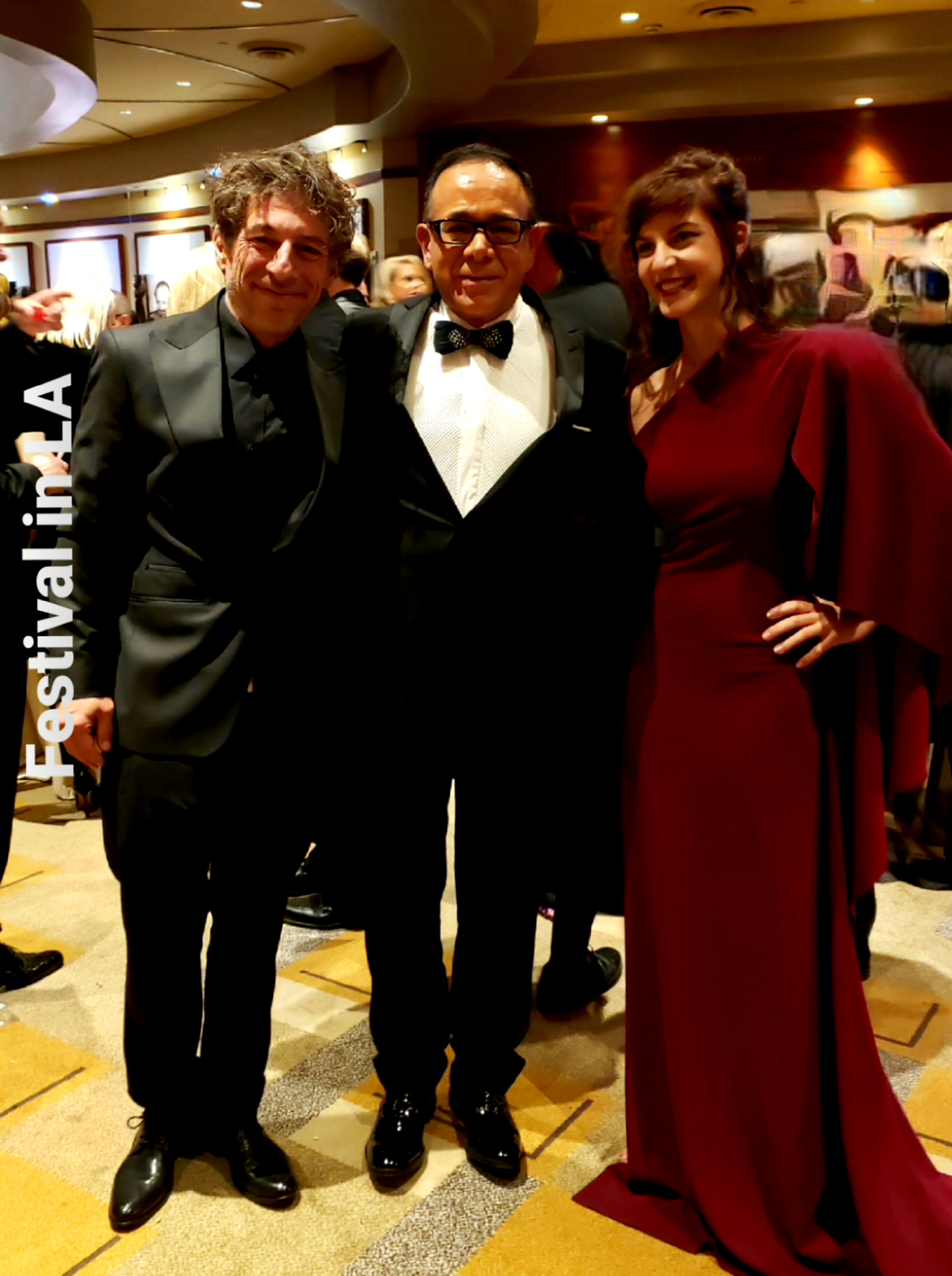
Film critic José Alberto Hermosillo. Photo: Gabriel Romero, Festival in LA ©2019
Ljubomir Stefanov and Tamara Kotevska, filmmakers of Honeyland. 
Film critic José Alberto Hermosillo, at the Academy Awards Festival in LA ©2020


TO ACCESS OUR INTERACTIVE FILM FESTIVAL CALENDAR FROM YOUR MOBILE PHONE, CLICK AT THE END: View web version. 
Festival in LA ©2019