
By José Alberto Hermosillo

“Gunda” is a fascinating, minimalist portrait of tranquil farm life, where pigs, chickens, and cows take center stage. “Gunda” is one of the best documentaries of the year!
 |
| Gunda director Victor Kosakovskiy. Photo: José Alberto Hermosillo, Festival in LA ©2020 |
Victor Kosakovskiy (“Aquarela,” ¡Vivan las Antipodas!) is an accomplished Russian documentarian.
In “Gunda,” he takes us on an observational journey with stunning cinematography, a nonintrusive camera, and crystal-clear sound. The film captivates audiences and has won awards at the Berlin and Stockholm film festivals, as well as nominations for Best Documentary at the European Film Awards and an IDA Award. Many may find the pace gridlocked yet compelling and thought-provoking.
 |
| Gunda, executive producer, Joaquin Phoenix. Photo: José Alberto Hermosillo, Festival in LA ©2020 |
Joaquin Phoenix, an animal rights activist, serves as the film’s executive producer. As he did in his acceptance speech at the 2020 Oscars, when he won Best Actor for “Joker,” he advocates for love and compassion toward other species and for intelligent, humane ways to balance the food chain.
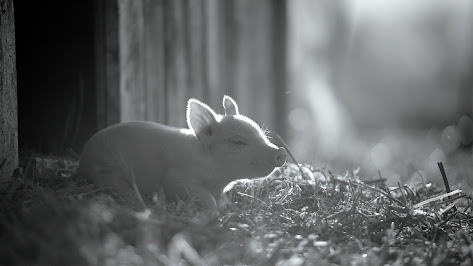
The documentary raises awareness of how domestic animals express emotions through their behavior. We see a mama pig caring for her piglets, caged chickens experiencing freedom for the first time, and cows running freely in the fields.
 |
| “Gunda.” Photo courtesy of NEON. |
The film opens with a steady shot of a barn’s exterior. Inside, a mother pig is giving birth to about a dozen piglets. It is a miracle of life. As each little pig is born, we fall in love with them. They are adorable! – It is also what the protective mother pig thinks. The day passes, and the entire pack goes out for a stroll to discover the delights of the dirt in their vast universe.
When a flock of caged chickens slowly and cautiously moves out, the physical damage sustained over an entire life in captivity is evident. One chicken is missing a leg, and others are missing many feathers, all disoriented.
The fascinating trend continues with a gorgeous display of big, healthy cows interacting and
running freely in the open. Those images make us think about all sorts of things, such
as how valuable life is to everyone in the field, even to those domestic creatures we cage, kill, and consume in our daily diet.
When Kosakovskiy decided to make a silent film in white, he wanted the audience to experience, in the first person, a glimpse of farm life. He knew he
needed to spend months with the best equipment possible—the best camera and
sound, no music sugar-coating, and plenty of inspiring
images of nature.
For years, Kosakovskiy needed help raising the budget to make this film, and pitching a black-and-white trilogy movie with pigs, chickens, and cows as the main stars was hard. To convince producers to invest in his project, he cited other similar successful films such as “Ida,” “Cold War,” and “Roma.” Now, he is glad the producers could see his vision and the intention to shoot a naturalistic film.
 |
| “Gunda.” Photo courtesy of NEON. |
The small camera crew worked tirelessly from noon until sunset to capture the animals’ actions and reactions. Those long hours were nothing compared with the precious moments they captured, which dramatically enhanced the story.
Kosakovskiy’s experience in the cinema led him to make the right decisions, using long lenses to avoid distracting the animals. To do so, he needed the best steadicam operator to maintain the proper distance between the camera and the subject, avoid being invasive with the animals, and avoid altering the natural outcome. Photographing living beings from far away was not an aesthetic choice but a moral one.
In a movie set, the director is always in control of every situation. In this documentary, the director had to be patient and not dictate what he couldn’t control, such as animal behavior, weather, and human challenges. To make “Gunda,” the filmmakers traveled to animal sanctuaries in Norway, Spain, and the United Kingdom.
 |
| Hollywood Legion Theater Photo: José Alberto Hermosillo, Festival in LA ©2020 |
Kosakovskiy said after a drive-in screening at the Hollywood Legion Theater, “Making this movie changed the way I see life.” The intention was to show farm life without saying anything and to understand what a mother pig feels: seriousness, sadness, and hopelessness.
 |
| “Gunda.” Photo courtesy of NEON. |
He continued the conversation. “All those creatures have a soul, and discovering those emotions is moving. The pig compellingly talked to us. In the very last scene, the pig’s behavior looks scripted. It was a
miracle; the team cried.”
The film helps us determine the similarities between animal and human behavior.
After admiring such a marvelous work of art, I decided to eliminate “Lechón Asado” from my Cuban diet. I am not Cuban; I am just a lover of the world’s cuisine. I am also becoming more appreciative of my Mesoamerican culture, which is based on vegetables and insects.
As an agent of
change, I will continue to love eating my greens as much as this documentary
made me care about the voiceless creatures on farms around the world, because sustainable farming is possible.
“Barry” And “The Wonder Years” Of Barack Obama
And Then We Danced: Folk, Love & Pride in Georgia
IF YOU ARE READING FROM A MOBILE DEVICE, CLICK: view web version FOR OTHER COOL FEATURES SUCH AS TRANSLATE POWERED BY GOOGLE, AN INTERACTIVE FILM FESTIVAL CALENDAR, AND MORE.